
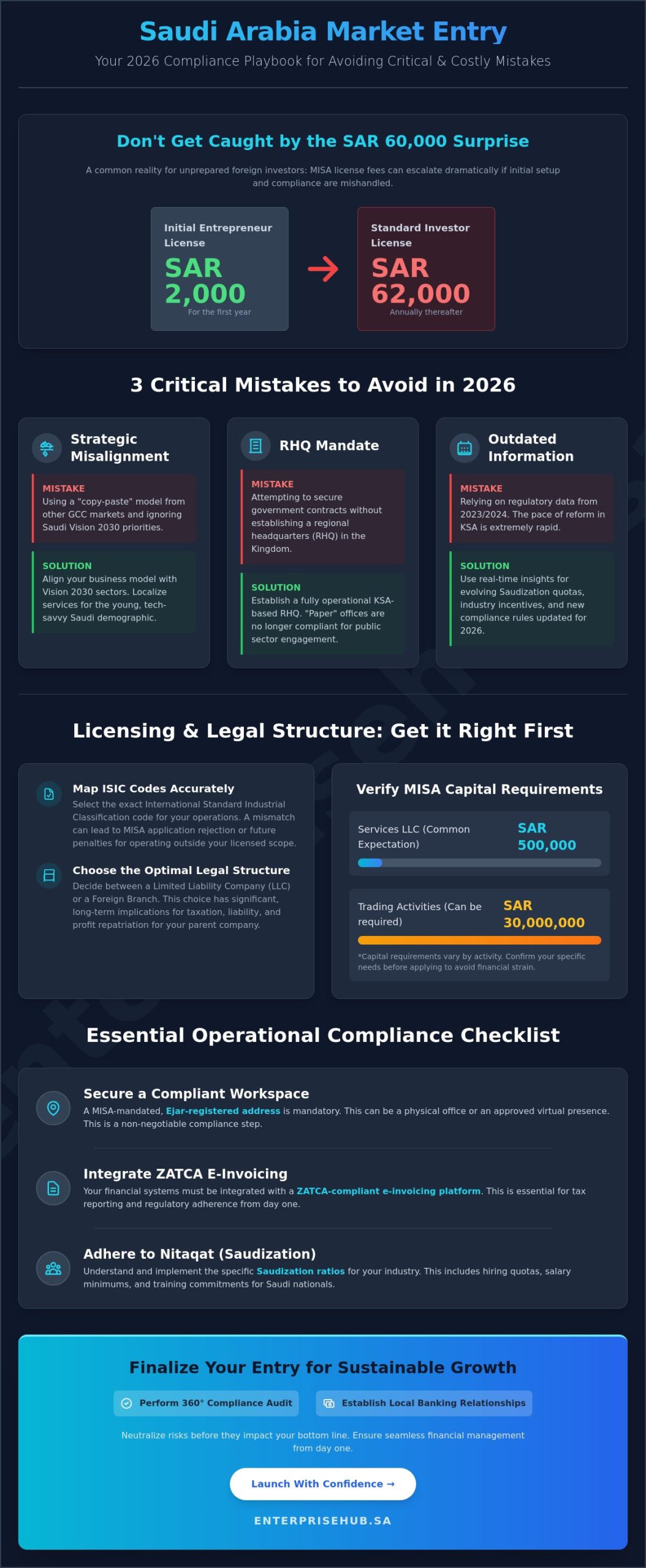
Did you know that your MISA license fee could jump from SAR 2,000 to SAR 62,000 in just twelve months? It’s a staggering reality that catches many foreign investors off guard. Entering the Saudi market is a bold strategic move, yet the fear of opaque regulatory requirements or the strict Anti-Concealment Law often creates unnecessary friction. To protect your capital and your reputation, you must learn how to avoid common mistakes when starting a company in Saudi Arabia before they impact your bottom line.
We understand that you’re looking for a clear path through the complexities of the 2026 landscape. This guide empowers you to master the Saudi business environment by neutralizing the regulatory and operational pitfalls that often derail new ventures. You’ll get a direct checklist of what to avoid, a streamlined path to your MISA license, and a strategy for a compliant physical or virtual presence. We’ll examine the 2026 Saudization targets for engineering and procurement while outlining the real costs of your first year in operation to ensure your growth remains uninterrupted.
Key Takeaways
- Align your business model with Vision 2030 sectoral priorities to ensure long-term strategic relevance instead of replicating models from other regional markets.
- Learn how to avoid common mistakes when starting a company in Saudi Arabia by accurately mapping ISIC codes and selecting the optimal legal structure for your goals.
- Secure a compliant physical or virtual presence through mandatory Ejar-registered addresses to satisfy strict MISA office mandates.
- Neutralize operational risks by integrating ZATCA-compliant e-invoicing and adhering to the latest Nitaqat (Saudization) ratios specific to your industry.
- Finalize your entry strategy with a comprehensive 360-degree compliance audit and establish essential local banking relationships for seamless financial management.
Establishing a Strategic Foundation: Beyond Basic Market Entry
Success in the Kingdom requires more than just a capital injection; it demands a deep understanding of Saudi Arabia’s Economic Landscape. Many investors fail because they treat the Saudi market as a simple extension of neighboring GCC economies. This “copy-paste” approach ignores the unique regulatory and cultural nuances that define the Kingdom in 2026. To truly avoid common mistakes when starting a company in Saudi Arabia, you must align your core mission with the nation’s long-term transformation goals. The Saudi consumer demographic has shifted rapidly, leaning toward a younger, tech-savvy population that expects localized, high-quality service rather than generic international offerings.
A critical strategic error involves the Regional Headquarters (RHQ) mandate. If your business model relies on securing government contracts, ignoring this requirement is a non-starter. The Saudi government no longer signs contracts with companies whose regional headquarters are located elsewhere. By 2026, this enforcement has become even more sophisticated, with strict audits to ensure these headquarters are operational hubs rather than mere “paper” offices. You can’t afford to overlook these structural shifts if you aim for large-scale public sector engagement.
Misjudging the Pace of Vision 2030 Regulatory Reforms
Relying on data from 2023 or 2024 is a recipe for immediate compliance failure. The regulatory environment moves at an incredible speed. For instance, specific Saudization quotas for engineering and marketing roles updated in early 2026 mean that your labor costs and recruitment strategies need immediate adjustment. We’ve seen high-growth sectors like renewable energy and digital infrastructure receive massive incentives, while traditional, “saturated” sectors face tighter margins. You need a tech-enabled differentiator to thrive in these established spaces. Don’t assume that yesterday’s rules apply to today’s opportunities.
Inadequate Feasibility Studies for Localized Operations
General market research often fails to account for Saudi regional logistics. Your feasibility study must analyze the competitive landscape between local giants and international entrants who already understand the nuances of the 2026 consumer. You must also evaluate the true cost of “Nitaqat” compliance within your specific niche. This isn’t just a percentage; it’s a financial commitment to training and salary minimums that vary by profession. We’ve seen businesses stall because they underestimated the operational costs of maintaining a physical or virtual presence that meets MISA’s evolving standards. A localized approach is the only way to ensure your growth remains sustainable and compliant.
Navigating Licensing Complexity: Sidestepping Regulatory Hurdles
Licensing in the Kingdom isn’t just a paperwork exercise; it’s a strategic framework that dictates your tax exposure and operational freedom. To avoid common mistakes when starting a company in Saudi Arabia, you must look beyond the initial application and focus on long-term structural integrity. A frequent pitfall involves mismapping business activities to ISIC codes. If you select a code that doesn’t perfectly match your intended operations, MISA may reject the application. Even if approved, operating outside your permitted scope can lead to heavy penalties during future audits. Precision in these early stages prevents costly delays that can stall your market entry by months.
Capital requirements also demand careful verification. While many service-based activities don’t have a statutory minimum, MISA commonly expects a capital of SAR 500,000 for foreign-owned Limited Liability Companies (LLCs). For trading activities, this requirement can be as high as SAR 30 million. Failing to account for these specific capital commitments before starting the process often leads to mid-incorporation financial strain. Once the MISA license is secured, you must move immediately to register with the Ministry of Commerce and the Chamber of Commerce. Delays in these secondary registrations will freeze your ability to open bank accounts or process employee visas.
The Trap of the Wrong Legal Structure
Choosing between an LLC, a Foreign Branch, or a Joint Stock Company has massive tax implications for your parent organization. An LLC is a separate legal entity, whereas a branch is an extension of the parent company, which changes how profits are taxed and repatriated. In 2026, 100% foreign ownership is widely available but requires specific MISA approvals and documented capital commitments. Successful company formation in Saudi Arabia requires a project-managed approach to legal selection to ensure the structure scales with your ambitions. We often see investors rush this decision, only to face expensive restructuring costs within their second year of operation.
MISA Compliance and the Anti-Concealment Mandate
The Anti-Concealment Law (Tasattur) is a major focus for Saudi authorities in 2026. This law targets businesses where a non-Saudi operates behind the name of a Saudi national without a proper MISA license. Enforcement levels have reached new heights with digital tracking and financial audits. You must ensure your local service agent agreements are legally transparent and “bulletproof.” According to the World Bank’s economic outlook for Saudi Arabia, the Kingdom’s regulatory reforms aim to create a fair, competitive market; making compliance a prerequisite for growth. Never sign a commercial lease before obtaining your MISA license. Doing so risks wasting capital on a space that might not meet the specific requirements of your eventual license type. If you’re feeling overwhelmed by these steps, our experts specialize in تأسيس الشركات to ensure every regulatory hurdle is cleared on time.
Securing Physical Infrastructure: The Link Between Compliance and Workspace
Many entrepreneurs view office space as a mere operational preference, but in the Kingdom, it’s a rigid licensing prerequisite. To avoid common mistakes when starting a company in Saudi Arabia, you must understand that your physical address is the anchor for your Commercial Registration (CR). Every business must have an “Ejar” registered address, which is a standardized electronic rental contract verified through the national portal. Without this document, the Ministry of Commerce won’t issue your final license. This requirement ensures that every entity has a legitimate, traceable presence, aligning with the official investment guidelines from MISA.
A frequent error is leasing traditional shell-and-core spaces before fully grasping the MISA headcount mandates. MISA often requires a specific amount of physical square footage based on the number of employee visas you intend to request. If you sign a long-term lease for a space that’s too small, you’ll face immediate roadblocks when trying to scale your team. Additionally, the “hidden” costs of traditional office fit-outs, such as utility connections, fire safety certifications, and municipality inspections, can quickly exceed your initial budget. We’ve seen setup costs for municipality (Baladiya) licenses alone range from SAR 1,000 to SAR 5,000 depending on location and activity.
The Mandatory Ejar Registration Mistake
Handshake agreements or informal subletting won’t work here. If your office isn’t properly registered on Ejar, you’ll be unable to secure a “Balady” license, which connects your physical site to your commercial activity. This failure often results in the immediate suspension of government services. For many consultants and tech startups, virtual offices in Saudi Arabia offer a compliant, low-risk bridge. These solutions provide a legitimate Ejar-registered address and a professional presence without the heavy capital expenditure of a long-term lease, allowing you to focus on growth while staying fully compliant with local laws.
Private Offices vs. Coworking: Matching Space to License
Choosing between serviced private offices and coworking spaces depends largely on your specific MISA license type and your Saudization targets. While coworking is excellent for networking, MISA often requires a dedicated, lockable private space to satisfy the requirements for certain professional or trading licenses. Serviced offices are becoming the gold standard for rapid market entry because they include utilities, maintenance, and furniture in a single fee. This approach helps you avoid common mistakes when starting a company in Saudi Arabia by eliminating the administrative burden of managing a facility. A prestigious business address also boosts your credibility with government clients, who value the stability and professionalism that a high-tier office location represents.
Financial and Talent Compliance: Managing Long-term Operational Risks
Operational success in the Kingdom isn’t just about surviving the first year; it’s about preparing for the fiscal step-up in the second. While your initial MISA license fee is a promotional SAR 2,000, your renewal in year two jumps to SAR 62,000. This increase is often the first “financial shock” for new investors. To avoid common mistakes when starting a company in Saudi Arabia, you must also prepare for the 20% Corporate Income Tax on net adjusted profits for the foreign-owned portion of your entity. Unlike some regional tax-free zones, the Saudi tax environment is rigorous and demands meticulous record-keeping from your very first transaction.
We’ve observed that many businesses underestimate the complexity of local tax filings. Once your revenue exceeds the SAR 375,000 threshold, VAT registration becomes mandatory. Operating at a 15% VAT rate requires precise monthly or quarterly filings to avoid penalties. By May 2026, the digital transformation of the Saudi economy has reached a point where manual accounting is no longer viable. Every riyal must be tracked through government-approved platforms to ensure your growth remains uninterrupted and legally sound.
ZATCA and Tax Regulatory Pitfalls
By 2026, ZATCA’s E-Invoicing (Fatoora) Phase 2 integration has become the standard for all B2B transactions. This phase requires your billing systems to connect directly with ZATCA’s servers for real-time validation. Failing to integrate or making errors in your VAT filings can lead to immediate financial penalties that drain your working capital. You can’t afford to treat accounting as an afterthought. Appointing a certified local partner ensures your books are compliant with both ZATCA requirements and International Financial Reporting Standards (IFRS) from day one.
Human Capital: The Qiwa and Nitaqat Ecosystem
Managing your team requires navigating the Qiwa and Mudad platforms with high precision. Qiwa centralizes all labor contracts, and you won’t be able to issue or renew work permits without it. A major risk is miscalculating your “Nitaqat” (Saudization) ratios. For example, as of June 30, 2026, companies with five or more engineers must maintain a 30% Saudi workforce. Similarly, sales and marketing roles now require a 60% Saudization rate as of April 19, 2026. Falling into the “Red Zone” freezes your ability to hire new expatriates or renew existing visas, effectively halting your operations.
The Wage Protection System (WPS), managed through the Mudad platform, tracks every salary payment. Any discrepancy between the registered contract and the actual bank transfer triggers an automatic red flag. Compliance here is the heartbeat of your operational legality. If you want to secure your fiscal future and ensure your team is fully compliant, our experts in المحاسبة والضرائب provide the strategic oversight needed to navigate these complex regulatory waters.
Success Roadmap: Transitioning from Setup to Sustainable Growth
Transitioning from a newly registered entity to a fully operational powerhouse requires a shift from administrative focus to strategic execution. To truly avoid common mistakes when starting a company in Saudi Arabia, you must conduct a final 360-degree compliance audit before your official launch. This audit ensures that your MISA license, Commercial Registration, and municipality permits are perfectly synchronized with your actual activities. Many businesses stall because they view setup as a one-time event rather than a continuous process of regulatory alignment. Establishing a relationship with a Tier-1 Saudi bank is your next priority. You should prepare for a rigorous Know Your Customer (KYC) process that can take several weeks; having your documentation in perfect order is essential to prevent delays in capital flow.
Scalability is the hallmark of a successful entry strategy. You need a flexible office solution that allows for 12-month headcount scaling without the need to relocate or renegotiate complex leases. We’ve seen that integrating local accounting and tax services into your daily operations from day one prevents the “compliance debt” that often plagues new ventures. Leveraging professional government relations services (PRO) ensures that ongoing renewals and visa processing are handled with precision, allowing your leadership team to focus on market share rather than paperwork.
The 90-Day Post-Incorporation Checklist
- Step 1: Finalize Chamber of Commerce membership. Set up your digital signature immediately to access the full suite of government portals and authenticate commercial documents.
- Step 2: Open the corporate bank account. This requires a complete set of notarized documents and often a physical meeting. Choosing a bank with strong digital services will simplify your future Wage Protection System (WPS) transfers.
- Step 3: Register on the National Address system. This is a mandatory requirement for all official correspondence and is used by various government agencies to verify your physical presence.
Partnering for Excellence: The Enterprise Hub Advantage
Enterprise Hub acts as your strategic partner by integrating premium office solutions with comprehensive government service support. We understand that your business needs to be agile yet fully compliant with MISA and Municipality standards. Our infrastructure provides the professional business address and operational environment required to satisfy high-level regulatory audits. We also bridge the gap between your setup and your daily operations by providing expert accounting and tax oversight. If you’re ready to secure your position in the Kingdom’s thriving economy, we invite you to contact Enterprise Hub for a comprehensive market entry consultation. Our team is dedicated to ensuring your transition from setup to sustainable growth is seamless and professional.
Secure Your Strategic Position in the Kingdom’s Future
Success in the Saudi market in 2026 requires shifting from simple registration to rigorous regulatory alignment. You’ve learned that choosing the right legal entity and securing an Ejar-registered address aren’t just administrative steps; they’re the foundations of your operational legality. To truly avoid common mistakes when starting a company in Saudi Arabia, you must integrate ZATCA-compliant e-invoicing and maintain strict Saudization ratios through the Qiwa platform. These requirements ensure your growth remains sustainable and protected from penalties.
Enterprise Hub has been a strategic partner since 2022. We offer deep local expertise to help you master these complexities. We provide fully equipped private offices and virtual solutions tailored to MISA and Ministry requirements, ensuring your business stays compliant from day one. Our comprehensive support covers everything from ZATCA integration to government service management, allowing you to focus on your core objectives.
Start your compliant journey in Saudi Arabia with Enterprise Hub and turn these regulatory challenges into your competitive advantage. The Kingdom’s economic transformation offers unparalleled growth; we’re here to ensure you lead the way with confidence and precision.
Frequently Asked Questions
Can a foreign investor own 100% of a company in Saudi Arabia in 2026?
Yes, most commercial and industrial sectors allow for 100% foreign ownership through a MISA investment license. While a few strategic sectors like military industries or specific retail activities may have restrictions, the vast majority of professional and trading services are open to full international ownership. You must ensure your capital commitments and business activities align with current MISA guidelines for your specific ISIC code.
What is the most common reason for a MISA license application to be rejected?
The most frequent cause for rejection is the misalignment between the parent company’s commercial registration and the requested ISIC activity codes in the Kingdom. To avoid common mistakes when starting a company in Saudi Arabia, you must provide consistent documentation that proves your expertise in the chosen field. Even minor discrepancies in translated documents or outdated financial statements can trigger an immediate administrative rejection during the initial screening.
How much physical office space is required to obtain a business license?
A minimum of 12 square meters is generally required for a standard professional business license, though this threshold increases based on your requested employee headcount. The Ministry of Human Resources and Social Development (MHRSD) expects your office to accommodate every visa holder you intend to hire. You must prove this through a verified Ejar contract that is linked to your Commercial Registration and municipality permit.
What are the penalties for violating the Saudi Anti-Concealment Law?
Violations carry severe consequences, including fines of up to SAR 5 million and imprisonment for up to five years. In 2026, the government uses advanced digital tracking to identify businesses where a non-Saudi operates under a local name without a proper investment license. Convicted entities face immediate liquidation, cancellation of all licenses, and a permanent ban on practicing commercial activities within the Kingdom.
How long does the typical company formation process take from start to finish?
The entire process usually spans 4 to 8 weeks, depending on the complexity of your legal structure. Obtaining the MISA license and Commercial Registration can happen relatively quickly; however, opening a corporate bank account and completing secondary registrations with ZATCA and GOSI often takes more time. Having all notarized and translated documents ready at the outset is the best way to ensure you stay within this timeline.
Is a virtual office address sufficient for all types of business licenses?
A virtual office is sufficient for many professional services and consulting firms that don’t require specialized municipality (Baladiya) inspections for physical goods. It provides a compliant Ejar-registered address that satisfies MISA requirements for an initial market entry. However, if your activity involves trading, manufacturing, or retail, you will likely need a dedicated private office or warehouse space to pass mandatory site inspections.
What is the “Saudization” requirement and how does it affect new startups?
Saudization, or Nitaqat, is a mandatory quota system that requires companies to employ a specific percentage of Saudi nationals. While startups often start in a grace period, they must quickly meet industry-specific targets to maintain hiring eligibility on the Qiwa platform. In 2026, specific roles in procurement, marketing, and engineering have high localized quotas that you must factor into your early-stage recruitment and payroll budget.
Do I need a local Saudi partner to start a professional services firm?
No, you can establish a professional services firm with 100% foreign ownership in most consulting and technical fields. To avoid common mistakes when starting a company in Saudi Arabia, focus on ensuring your technical staff hold the necessary accreditations from local bodies like the Saudi Council of Engineers. While a local partner is no longer a legal necessity for most, many firms still choose to collaborate with local experts for market access and cultural insights.