
What if the next ZATCA audit wasn’t a source of anxiety, but a validation of your company’s operational excellence? With Wave 24 of the Fatoora e-invoicing system requiring integration by June 30, 2026, the margin for error has disappeared. Partnering with a professional tax consulting office in Riyadh is no longer a luxury for large corporations; it’s a critical requirement for any business aiming to scale within the Kingdom’s digital economy.
You’ve likely felt the weight of shifting regulations, from the 15% VAT rate to the nuances of Zakat versus Corporate Tax for foreign investors. It’s stressful to manage these complexities while trying to avoid heavy penalties. We agree that the move toward Full Tax Intelligence feels like a moving target. This article provides a clear roadmap to master your tax obligations and take advantage of the current tax amnesty initiative ending in June. You’ll learn how expert guidance on Zakat, VAT, and e-invoicing phases transforms regulatory hurdles into a competitive advantage for your business growth.
Understand how Saudi Vision 2030 is reshaping the regulatory landscape and why strategic tax oversight is now vital for sustainable business growth.
Distinguish between Zakat, Corporate Tax, and the 15% VAT requirements to ensure your company meets its specific financial obligations with total transparency.
Prepare for the Wave 24 Fatoora deadlines with a clear roadmap for seamless ZATCA API integration and technical compliance.
Identify the essential criteria for selecting a reliable tax consulting office in Riyadh, including SOCPA certification and industry-specific expertise.
Discover how integrating a premium workspace at Enterprise Hub with professional tax and accounting services creates a streamlined environment for your success.
The Role of a Tax Consulting Office in Riyadh’s Evolving Economy
Riyadh’s business landscape is undergoing a profound transformation. Under the umbrella of Vision 2030, tax compliance has evolved from a routine administrative task into a core strategic pillar for every ambitious enterprise. A professional tax consulting office in Riyadh serves as the essential bridge between your business goals and the strict regulatory frameworks set by the Zakat, Tax and Customs Authority (ZATCA). This partnership is no longer just about avoiding fines; it’s about building a sustainable, transparent organization that contributes to the Kingdom’s economic prosperity.
The transition from manual bookkeeping to real-time digital tax reporting represents a historic shift. The Fatoora e-invoicing system has replaced traditional methods, demanding a higher level of technical and financial accuracy. Local expertise is particularly vital for navigating Zakat laws, which require a specialized understanding of Saudi-specific financial structures that differ significantly from international corporate tax models. By partnering with experts, you ensure your financial data isn’t just a record of the past, but a strategic tool for future growth.
Why Businesses Need Local Tax Expertise in KSA
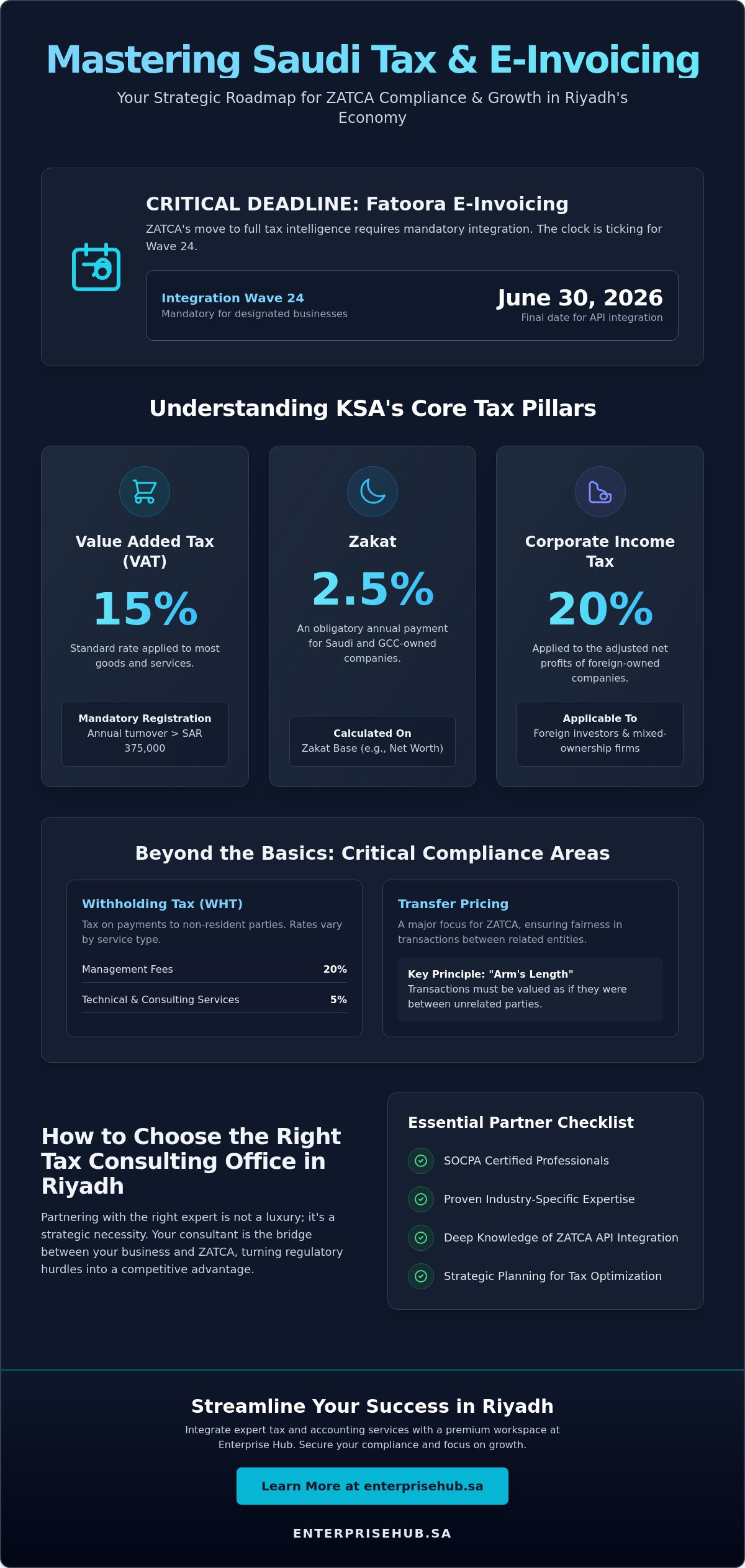
ZATCA is leveraging technology to achieve full tax intelligence, making oversight more precise than ever. With the Wave 24 integration deadline approaching on June 30, 2026, businesses with taxable revenue exceeding SAR 375,000 must be fully prepared. A local consultant helps you navigate these nuances, mitigating the risk of heavy penalties and ensuring you capitalize on the current tax amnesty initiative before it expires. Staying updated on these frequent regulatory changes is a full-time job that requires a dedicated expert on the ground who understands the local market’s pulse.
The Strategic Advantage of Professional Tax Planning
Professional tax planning offers a distinct advantage for international investors and local firms alike. It’s about optimizing your corporate structure to ensure seamless eligibility for government tenders and MISA licenses. We ensure your financial reporting aligns perfectly with Saudi Organization for Certified Public Accountants (SOCPA) standards, fostering trust with regulators and stakeholders. A specialized tax consulting office in Riyadh provides the clarity needed to make informed investment decisions while maintaining an impeccable record of compliance.
Essential Tax Services: Zakat, VAT, and Corporate Tax
Mastering the technical details of Saudi Arabia’s tax regime is the foundation of any successful business strategy. Since the standard Value Added Tax (VAT) rate was adjusted to 15%, businesses have had to refine their financial processes to ensure precision. For most entities, mandatory registration is required once annual taxable turnover exceeds SAR 375,000. Managing these filings isn’t just about data entry; it’s about interpreting complex regulations found on the official ZATCA portal to avoid costly oversights. A specialized tax consulting office in Riyadh provides the necessary oversight to ensure every transaction is categorized correctly, protecting your bottom line.
Beyond VAT, companies must manage Withholding Tax (WHT) on payments made to non-resident parties. These rates vary significantly, ranging from 5% for technical services to 20% for management fees. Additionally, Transfer Pricing has become a major focus for ZATCA, especially for multinational groups. Ensuring that transactions between related parties are conducted at “arm’s length” is now a critical requirement to remain compliant and avoid aggressive audits. This level of detail requires more than just a bookkeeper; it demands a strategic partner who understands the broader fiscal landscape.
Zakat vs. Corporate Tax: What You Need to Know
The distinction between Zakat and Corporate Income Tax (CIT) is a unique feature of the Saudi market. Saudi and GCC-owned companies are subject to Zakat, calculated at 2.5% of the Zakat base, which includes net worth and long-term financing rather than just net profit. Conversely, foreign-owned companies pay a 20% corporate tax on adjusted net profits. Mixed-ownership firms must split their filings accordingly. Missing a deadline or miscalculating the Zakat base can lead to significant financial friction, making accurate, SOCPA-aligned financial statements non-negotiable.
VAT Compliance and Refund Strategies
Effective VAT management goes beyond simple reporting; it involves optimizing your cash flow. By accurately tracking input tax on business purchases, you can offset it against the 15% output tax collected from customers. This is particularly important for businesses dealing with zero-rated supplies, such as certain healthcare or international transport services, where you may be eligible for a VAT refund. If your business consistently has excess input tax, a structured refund application can inject vital liquidity back into your operations. To streamline these complex filings, many firms integrate their accounting and tax services with their core operations to maintain real-time visibility. A professional tax consulting office in Riyadh ensures you never miss a deduction while staying fully aligned with the latest ZATCA mandates.
Navigating ZATCA Compliance and E-Invoicing (Fatoora)
Saudi Arabia’s transition to Phase 2 of the Fatoora system marks a significant milestone in digital governance. Unlike Phase 1, which focused on the simple generation of electronic invoices, Phase 2 requires a direct, real-time integration with the Zakat, Tax and Customs Authority (ZATCA). This means your internal accounting systems must now communicate directly with government servers through a secure API. For businesses in the capital, working with a tax consulting office in Riyadh is the most efficient way to manage this technical bridge without disrupting daily operations. The Wave 24 deadline on June 30, 2026, for businesses with revenue exceeding SAR 375,000 makes this integration an urgent priority.
Integration isn’t a one-time setup. It involves a sophisticated connection that transmits invoice data in specific XML or PDF/A-3 formats. A consultant ensures your software isn’t just a basic tool but a fully audited system capable of handling ZATCA’s clearance and reporting protocols. Data accuracy is paramount because once an invoice is cleared, it becomes a permanent record in the national tax database. Real-time reporting allows the government to monitor transactions as they happen, leaving no room for manual adjustments or retroactive corrections. This level of transparency demands that your financial data is flawless from the moment of entry.
Steps to Achieving Full E-Invoicing Integration
Transitioning to the Integration Phase requires a methodical approach to ensure technical stability. We recommend following these three essential steps:
- Step 1: Selecting a ZATCA-compliant solution. Your ERP or accounting software must be verified for Phase 2 compatibility and capable of generating the required digital signatures.
- Step 2: Onboarding devices. This involves generating Cryptographic Stamp Identifiers (CSIDs) for every point-of-sale or invoicing device within your business network.
- Step 3: Rigorous Testing. You must test the generation of XML invoices and the clearance/reporting process in a staging environment to ensure the API connection is seamless.
Common Pitfalls in ZATCA Reporting
Many businesses struggle with data synchronicity. A frequent error is a mismatch between the human-readable physical invoice and the digital XML file transmitted to ZATCA. Additionally, for simplified tax invoices (B2C), firms often fail to meet the strict 24-hour reporting window required by the authority. In 2026, non-compliance with e-invoicing requirements can lead to substantial financial penalties and potential suspension of business activities. Partnering with a tax consulting office in Riyadh provides the technical and regulatory oversight needed to turn compliance from a burden into a streamlined digital asset.
How to Choose the Right Tax Consulting Office in Riyadh
Selecting the right partner for your fiscal health is a high-stakes decision. In a regulatory environment that moves as fast as Saudi Arabia’s, you need more than just a service provider. You need a strategic ally. The first step is verifying that any tax consulting office in Riyadh you consider holds a valid SOCPA certification. This isn’t just a badge of honor; it’s your guarantee that the firm operates under the highest professional standards and possesses the technical authority to represent you before ZATCA. Additionally, ensure they carry professional indemnity insurance to safeguard your interests against unforeseen errors.
Industry-specific experience is equally vital. The tax challenges of a high-tech startup differ wildly from those of a large-scale real estate developer. Ask potential consultants about their track record in your specific sector. Can they demonstrate success in managing complex VAT structures or high-value Zakat appeals for firms like yours? Digital readiness is the final piece of the puzzle. With the Wave 24 integration deadline looming, your consultant must be tech-savvy enough to audit your ERP systems and ensure your e-invoicing software is fully compliant with Phase 2 requirements.
Evaluating Local Market Knowledge
Success in the Saudi market requires deep local roots. Your consultants should be fluent in Arabic to navigate the nuances of the ZATCA portal and official government correspondence effectively. Proximity to major business hubs, such as the King Abdullah Financial District (KAFD), often signals a firm that is well-connected to the latest regulatory shifts and market insights. This local presence allows for a more responsive service, ensuring that your tax consulting office in Riyadh can act quickly when new circulars or tax amnesty initiatives are announced.
The Value of Integrated Professional Services
Efficiency thrives when your professional services are unified. Many high-growth companies find that pairing tax advice with business setup services reduces administrative friction significantly. When your legal structure, government relations, and accounting are handled under one roof, data flows seamlessly, and compliance becomes a natural outcome of your operations. It’s also critical to ensure your virtual office address meets all ZATCA registration requirements to avoid delays in obtaining your tax identification number. By centralizing these functions, you empower your team to focus on innovation while we handle the complexities of the Saudi regulatory landscape. Explore our comprehensive business solutions to see how we can streamline your path to success.
Enterprise Hub: Integrating Tax Support with Premium Workspaces
Enterprise Hub serves as the definitive landing pad for visionary businesses entering the Saudi market. We understand that establishing a presence in the Kingdom involves more than just finding a desk; it requires a comprehensive support system that addresses legal, operational, and fiscal needs simultaneously. By choosing a tax consulting office in Riyadh that is integrated into your physical workspace, you eliminate the fragmentation that often slows down international expansion. Our ecosystem is designed to ensure that your financial reporting and MISA compliance are managed with the same precision as your daily operations.
Having your accounting and tax support under the same roof as your executive team fosters a culture of transparency and speed. Instead of managing multiple vendors across different time zones, you gain a single point of contact for your corporate requirements. This holistic approach ensures that every ZATCA filing, VAT return, and Zakat calculation is aligned with your broader business strategy. It’s about empowering your leadership to focus on growth while we handle the regulatory heavy lifting. A tax consulting office in Riyadh within a business hub provides the real-time access needed to resolve queries before they become compliance issues.
Why KAFD is the Strategic Choice for Your Tax-Compliant Office
Operating from the King Abdullah Financial District (KAFD) provides immediate credibility with banks and regulatory bodies. A KAFD address isn’t just a status symbol; it’s a signal to ZATCA and other authorities that your business is part of the Kingdom’s elite financial core. This location offers the modern digital infrastructure necessary to support the high-speed tech requirements of Phase 2 e-invoicing. Within this hub, you are surrounded by a network of financial experts and professional service providers, making it easier to stay ahead of regulatory shifts and national economic trends.
Comprehensive Support for Global and Local Brands
Our services are built to scale alongside your ambitions. Whether you are a solo entrepreneur starting with a private office rental or a multinational firm requiring full-scale tax management, we provide the flexibility you need. We bridge the gap between global business standards and local Saudi requirements, ensuring your brand remains reputable and compliant. Don’t leave your fiscal health to chance. Contact Enterprise Hub today to secure an integrated office and tax solution that propels your business toward the goals of Vision 2030.
Empowering Your Strategic Growth in Riyadh’s Digital Economy
Navigating the Saudi tax landscape requires more than just meeting deadlines; it’s about turning regulatory requirements into a foundation for excellence. As the June 30, 2026, Wave 24 integration deadline and the tax amnesty initiative approach, the need for precision has never been higher. By leveraging a specialized tax consulting office in Riyadh, you ensure that your Zakat calculations, VAT filings, and e-invoicing protocols are handled with the highest level of SOCPA-aligned expertise. This proactive approach doesn’t just shield your business from penalties; it positions you as a reliable player in the Kingdom’s ambitious economic transformation.
We’ve built an ecosystem where your physical workspace and professional compliance needs coexist seamlessly. At Enterprise Hub, we combine a prestigious KAFD presence with a dedicated team focused on full-service business establishment and ZATCA compliance. This integration removes the administrative friction that often hinders high-growth firms. Secure your KAFD office and professional tax support at Enterprise Hub to experience a partnership that prioritizes your prosperity. Your journey toward the goals of Vision 2030 starts with the right environment and the right experts by your side. We’re ready to help you thrive.
Frequently Asked Questions
What are the main taxes a business must pay in Saudi Arabia?
Businesses in Saudi Arabia primarily manage Value Added Tax (VAT) at a standard rate of 15%, Zakat for Saudi and GCC nationals, and Corporate Income Tax for foreign investors. Additionally, companies must account for Withholding Tax on international payments and undeveloped land taxes where applicable. Ensuring these are categorized correctly is vital for maintaining a clean regulatory record.
Is it mandatory for a small business to hire a tax consulting office?
While hiring a tax consulting office in Riyadh isn’t a legal requirement, it’s a strategic necessity for managing the technical complexities of the Fatoora e-invoicing system. Small businesses often find that professional oversight prevents costly errors in Zakat base calculations and VAT filings. This partnership allows you to focus on growth while experts handle the evolving ZATCA mandates.
What is the current VAT rate in Saudi Arabia for 2026?
The standard Value Added Tax (VAT) rate in Saudi Arabia for 2026 remains at 15% on most goods and services. Businesses with annual taxable turnover exceeding SAR 375,000 must register for VAT. Those with turnover between SAR 187,500 and SAR 375,000 may choose to register voluntarily to claim input tax credits.
How does Zakat differ from Corporate Tax for foreign investors?
Zakat is an Islamic levy of 2.5% calculated on the Zakat base, which includes net worth and long-term financing, applicable to Saudi and GCC nationals. Corporate Tax is a 20% levy on the adjusted net profits of foreign-owned shares in a company. Mixed-ownership firms must split their filings to reflect the specific ownership percentages of each partner.
What is Phase 2 of ZATCA e-invoicing and does it apply to me?
Phase 2 is the Integration Phase, requiring your accounting software to connect directly to ZATCA’s servers via an API for real-time reporting. If you’re a VAT-registered taxpayer with revenue exceeding SAR 375,000, you’re required to integrate by the Wave 24 deadline on June 30, 2026. This phase demands higher technical accuracy than the initial generation phase.
Can I register my ZATCA tax address at a virtual office in KAFD?
Yes, you can use a virtual office address for ZATCA registration if the provider offers a compliant contract and proper documentation. At Enterprise Hub, our KAFD-based virtual offices provide the regulatory credibility and official address needed to satisfy ZATCA and MISA requirements. This allows your business to maintain a prestigious presence while remaining fully compliant.
What penalties does ZATCA impose for late tax filings?
ZATCA imposes various financial penalties for late registration, filing, and payment, which can significantly impact your cash flow. However, the authority has extended its tax amnesty initiative until June 30, 2026. This initiative exempts taxpayers from many fines provided the principal tax amount is settled within the specified period.
How often should a company conduct a tax health check?
We recommend conducting a comprehensive tax health check at least once a year to ensure all processes align with the latest SOCPA standards. For high-growth firms or those with annual revenue exceeding SAR 40 million, quarterly reviews are more effective. Regular checks help identify potential risks in your e-invoicing data before they trigger a formal ZATCA audit.