
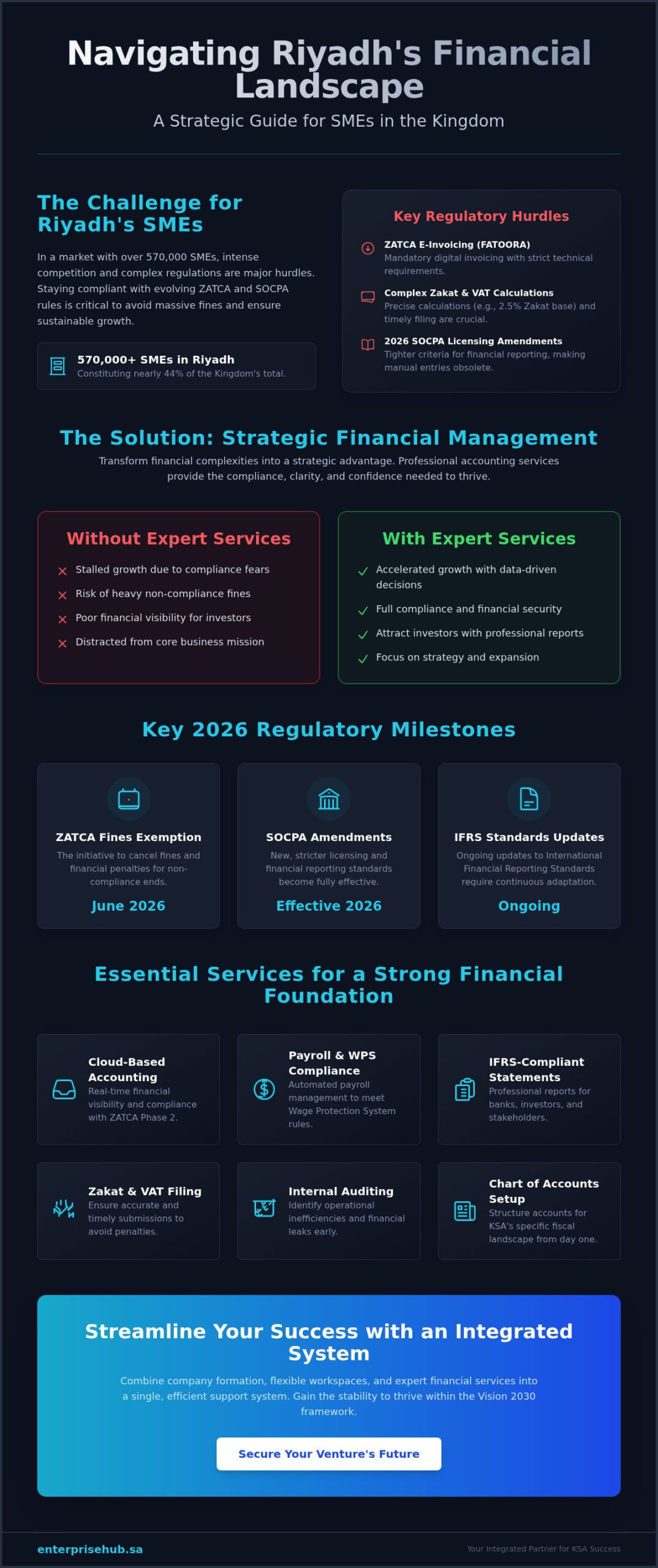
With over 570,000 SMEs now operating in Riyadh, representing nearly 44% of the Kingdom’s total, the competition for market share is as intense as the regulatory scrutiny. You’ve likely felt the weight of ZATCA’s evolving requirements, from the mandatory FATOORA e-invoicing to the complex 2.5% Zakat base calculations. The fear of massive non-compliance fines or confusion over the 2026 SOCPA licensing amendments can easily distract you from your core mission. It’s a common hurdle, but it shouldn’t be the reason your growth stalls.
Partnering with expert accounting services for small businesses in Riyadh transforms these financial complexities into a powerful strategic advantage. We’re here to ensure your venture remains fully compliant while providing the clear financial visibility that modern investors demand. This guide explores the essential 2026 regulatory updates, including the ZATCA fines exemption initiative ending in June 2026 and the latest IFRS standards. You’ll learn how an integrated support system for company setup and accounting provides the stability needed to thrive within the Vision 2030 framework.
Key Takeaways
- Learn how to transition from basic bookkeeping to strategic financial management that aligns with Saudi Vision 2030 objectives.
- Identify the essential Zakat and VAT filing requirements to protect your venture from costly non-compliance penalties.
- Secure the right accounting services for small businesses in Riyadh to navigate the 2026 SOCPA amendments and IFRS updates with confidence.
- Streamline your operations by integrating company formation, flexible workspaces, and tax services into a single, efficient support system.
- Gain real-time financial visibility through cloud-based accounting and automated payroll compliance with the Wage Protection System.
Why Professional Accounting Services for Small Businesses are Non-Negotiable in 2026
Strategic financial management has replaced basic bookkeeping as the minimum requirement for success in the Kingdom. You aren’t just tracking expenses; you’re building a roadmap. Professional accounting services for small businesses in Riyadh act as a compass in an economy that rewards precision. They transform raw numbers into actionable insights. This clarity allows you to make bold decisions with confidence. You move from simply reacting to market changes to proactively shaping your company’s future.
The national push toward Saudi Vision 2030 has opened doors for millions of entrepreneurs. Non-oil sectors are thriving. To capture this momentum, your business needs a solid financial foundation. Professional oversight ensures you don’t miss opportunities due to poor record-keeping. It shifts your focus from daily fires to strategic expansion. You gain the freedom to lead while experts handle the complexities of financial compliance. Transitioning from survival mode to data-driven growth requires this level of professional dedication.
The Evolving Regulatory Environment in KSA
SOCPA’s recent amendments have tightened the criteria for financial reporting. Manual entries are no longer viable; they’re a liability. Digital-first mandates from ZATCA require immediate, accurate data synchronization across all platforms. This level of precision is especially critical during company formation in Riyadh. Establishing correct accounting protocols from the start saves time and resources. It builds a legacy of compliance that supports long-term stability and protects you from unforeseen regulatory shifts.
Accounting as a Growth Catalyst
Financial statements are your business’s resume. They are the first thing local and international investors request before committing capital. Accurate, professional reports demonstrate a level of maturity that attracts serious partners. High-quality accounting services for small businesses in Riyadh also simplify the process of opening corporate bank accounts or securing lines of credit. Transparency gives you a competitive edge. It signals to the market that your operations are ethical, organized, and ready for scale. You become a trusted player in a market that values integrity and clear financial visibility.
Essential Accounting & Bookkeeping Services for Saudi Startups
Moving from a MISA license to a fully operational entity requires a robust financial framework. Startups often struggle with this transition, yet it’s where the most critical compliance mistakes happen. High-quality accounting services for small businesses in Riyadh provide the necessary bridge by establishing cloud-based systems that offer real-time visibility. These digital tools aren’t just convenient; they’re a requirement for Phase 2 of the Zakat, Tax, and Customs Authority (ZATCA) e-invoicing mandate. By automating data entry, you reduce human error and ensure that every transaction is audit-ready from day one.
Beyond simple record-keeping, startups must navigate the complexities of the Wage Protection System (WPS). Payroll management in KSA isn’t just about cutting checks; it’s about ensuring every payment is documented and reported to the Ministry of Human Resources and Social Development. Professional oversight ensures your payroll remains compliant, avoiding the stiff penalties associated with delayed or incorrect filings. Additionally, preparing IFRS-compliant financial statements for SMEs is no longer optional. These standards provide a universal language for your business health, making it easier to communicate with banks and stakeholders. Internal auditing further strengthens this foundation by identifying operational leaks or inefficiencies before they escalate into financial crises.
Bridging the Gap from Setup to Operation
Establishing a Chart of Accounts that mirrors the Saudi fiscal landscape is your first priority. This structure must account for specific local requirements, including Zakat and VAT classifications. We’ve seen that integrating these financial systems with virtual office solutions creates a seamless administrative flow. This setup allows founders to manage their corporate presence and their books from a single digital interface, reducing overhead significantly. It’s about building internal controls that manage cash flow effectively before a single riyal is spent.
Financial Reporting for Stakeholders
Founders need data they can understand without having a CPA degree. Monthly reporting is generally recommended for startups to catch burn rate issues early, while quarterly reports satisfy most regulatory filings. Customized dashboards translate complex ledgers into visual trends, showing you exactly where your capital is going. This visibility is vital for budgeting and forecasting the next fiscal year, ensuring you remain attractive to potential investors. If you’re ready to secure your financial future, exploring integrated accounting and tax solutions can provide the clarity your business deserves.
Navigating Zakat, Tax, and SOCPA Compliance Without the Stress
Small business owners in KSA often carry a heavy emotional load. The fear of ZATCA penalties or missing a critical filing deadline can keep you awake at night. This anxiety is real, but it’s manageable. Professional accounting services for small businesses in Riyadh act as your strategic shield. We don’t just file forms; we provide the certainty that your business stands on firm legal ground. By delegating these complexities, you reclaim the mental energy needed to innovate and lead your team toward success.
Understanding your obligations is the first step toward peace. VAT registration is a primary hurdle. It becomes mandatory when your annual taxable turnover hits SAR 375,000. Managing the standard 15% rate requires consistent record-keeping to avoid cash flow disruptions. For those working with international partners, Withholding Tax (WHT) adds another layer of responsibility that must be settled monthly. You must also ensure your year-end requirements are handled by SOCPA-certified auditors. Their expertise is vital for meeting the 2026 SOCPA amendments, which have tightened reporting duties and audit documentation for all accounting professionals.
Zakat vs. Income Tax: What Applies to You?
Ownership determines your tax profile. Entities wholly owned by Saudi or GCC nationals fall under Zakat regulations. If your business has foreign ownership, Corporate Income Tax at a rate of 20% applies to that portion of the profits. Proper documentation of your Zakat base is the only way to optimize your position and ensure accuracy. For small businesses, the current Zakat rate is 2.5% of the Zakat base.
E-Invoicing (Fatoora): Staying Compliant in a Digital Era
The transition to e-invoicing is no longer a future goal; it’s a current reality. The Fatoora initiative requires all VAT-registered businesses to generate invoices through compliant electronic systems. Integrated accounting services for small businesses in Riyadh automate this linkage, ensuring every QR code meets ZATCA’s Phase 2 standards. This automation eliminates the risk of manual errors and protects your reputation. You should act now to take advantage of the Fines Exemption Initiative, which ZATCA has extended until June 2026. This grace period is a rare opportunity to refine your digital processes without the threat of immediate financial penalties.
Selecting the Right Accounting Partner for Your Business Growth
Choosing an accounting partner is a pivotal decision that dictates your company’s trajectory. You aren’t simply outsourcing data entry; you’re selecting a strategic ally to protect your assets. High-quality accounting services for small businesses in Riyadh should act as a bridge between your current operations and your future expansion goals. A systematic evaluation helps you filter through the noise to find a partner who truly understands the KSA market.
- Evaluate technical expertise: Ensure they have a proven track record in your specific industry, whether it’s tech, retail, or manufacturing.
- Verify SOCPA accreditation: Accreditation is non-negotiable. It guarantees that the firm adheres to the latest Saudi professional and ethical standards.
- Assess the technology stack: Modern firms must use cloud-based tools that offer real-time data access and seamless ZATCA integration.
- Consider the “Hub” factor: Look for a partner who can handle more than just numbers. A firm that integrates workspace, company formation, and accounting provides a unified support system.
- Review communication styles: Your accountant should be responsive and proactive, translating complex financial data into clear, actionable advice.
Local Expertise vs. International Standards
Success in the Kingdom requires a delicate balance between local regulations and global best practices. An accountant who understands the “Saudi way” of business can navigate the nuances of local Zakat laws while ensuring your records meet IFRS standards. This dual expertise is essential for any founder investing in Saudi Arabia. A local partner provides the cultural and regulatory context that international-only firms often miss, helping you build trust with local banks and government entities from day one.
The Cost of “Cheap” Accounting
Cutting corners on financial oversight is a high-risk gamble. Unlicensed freelancers or low-tier firms might offer lower fees, but they often lack the insurance or expertise to handle complex ZATCA audits. The hidden costs of errors, late filings, and non-compliance fines far outweigh the initial savings. Instead, calculate the ROI of professional financial advice. An “Accounting-as-a-Service” model is often the most cost-effective path for SMEs. It provides access to a full team of experts for a fraction of the cost of a full-time, in-house department. If you’re ready to secure your growth with a partner who understands every facet of the Saudi business landscape, discover how our integrated accounting and business solutions can empower your journey.
Enterprise Hub: Integrating Workspace and Financial Support for KSA Success
Managing a new venture in the Kingdom often feels like juggling separate worlds. You deal with office leases, legal formation, and tax compliance as isolated tasks. Our “One Hub” philosophy changes this dynamic. We’ve built an ecosystem where your physical presence and financial health are managed under one roof. By providing integrated accounting services for small businesses in Riyadh alongside premium workspace solutions, we eliminate the friction that typically slows down growth. You don’t just get a desk; you get a strategic foundation designed for the 2026 economic climate.
Our location in the King Abdullah Financial District (KAFD) places you at the center of Saudi Arabia’s financial evolution. This isn’t just about prestige. It’s about being where the decisions are made and where the future of Vision 2030 is written. In the first quarter of 2026 alone, 71,000 new businesses were registered in the Kingdom, bringing the total active registrations to 1.89 million. We empower these entrepreneurs by offering a one-stop support system. From private offices to sophisticated cloud accounting, we ensure your infrastructure is as ambitious as your goals.
Comprehensive Support for Foreign and Local Investors
The journey from obtaining a MISA license to active operational bookkeeping is often where founders feel most vulnerable. We bridge this gap by handling the transition with precision. A prestigious business address is a requirement for your Commercial Registration (CR) and subsequent regulatory filings. We provide that address while our dedicated accounting specialists set up your books to meet SOCPA standards. This ensures you’re ready for ZATCA’s requirements from day one, allowing you to focus on your market entry strategy rather than administrative hurdles.
Your Strategic Partner in the Saudi Market
Startups and scale-ups have unique needs that “one-size-fits-all” firms often ignore. We offer customized accounting packages that grow as you do. Whether you need monthly reporting or deep-dive internal audits, our team is aligned with your SME journey. Beyond the numbers, you have access to our world-class meeting rooms and facilities. These spaces are perfect for presenting your financial growth and transparency to potential investors. We are more than a service provider; we are a partner in your prosperity. Experience a higher standard of business support at Enterprise Hub and secure your place in the Kingdom’s thriving economy.
Empowering Your Vision in the Kingdom’s Financial Future
Building a successful venture in KSA requires more than just a great idea; it demands a rock-solid financial and operational foundation. You’ve seen how staying ahead of ZATCA’s e-invoicing phases and SOCPA’s 2026 amendments protects your business from unnecessary risks. Strategic accounting services for small businesses in Riyadh do more than just balance books; they provide the clarity needed to navigate a market that is diversifying at an unprecedented pace. By integrating your financial management with a professional corporate presence, you create a seamless path from initial setup to long-term scale.
We’re committed to your success as a strategic partner in this journey. Our SOCPA-aligned expertise and strategic KAFD business address ensure your company meets the highest professional standards while remaining at the heart of the Saudi economy. You don’t have to manage these complexities alone. Secure your business future with Enterprise Hub’s integrated accounting and workspace solutions. Let’s work together to turn your ambitious goals into a lasting legacy of prosperity and growth in the Kingdom.
Frequently Asked Questions
Do small businesses in Riyadh need to be registered with SOCPA?
Individual small businesses don’t register with SOCPA; however, the accounting professionals or firms they hire must be licensed by the Saudi Organization for Chartered and Professional Accountants. It’s vital to verify these credentials to ensure your financial statements comply with the 2026 regulatory amendments. Utilizing certified accounting services for small businesses in Riyadh guarantees that your records meet the highest national standards for accuracy and legal validity.
What is the standard VAT rate for small businesses in KSA for 2026?
The standard VAT rate remains 15% for most goods and services in 2026. This applies to all businesses with an annual taxable turnover exceeding the mandatory threshold of SAR 375,000. You must ensure your pricing and accounting systems are configured to track this accurately, as ZATCA requires precise digital reporting through the Fatoora system to maintain your compliance status.
Can a foreign-owned small business benefit from Zakat laws?
Zakat laws only apply to companies wholly owned by Saudi or GCC nationals. Foreign-owned entities, or the foreign-owned portion of a joint venture, are subject to Corporate Income Tax at a rate of 20% on net adjusted profits. It’s a common point of confusion for new investors, so you should consult with a specialist to ensure you’re filing under the correct tax regime based on your ownership structure.
What are the penalties for late Zakat or VAT filing in Saudi Arabia?
Late filings can result in significant financial penalties, often calculated as a percentage of the tax or Zakat due for each month of delay. These fines can quickly escalate and impact your company’s cash flow and reputation. Fortunately, ZATCA has extended the Fines Exemption Initiative until June 2026, providing a strategic window for businesses to correct past errors and align with current regulations without incurring specific penalties.
Is it better to hire an in-house accountant or outsource for a startup?
Outsourcing is generally the more strategic and cost-effective choice for startups and scale-ups. It provides immediate access to a full team of experts for a fraction of the cost of a full-time, in-house salary. Professional accounting services for small businesses in Riyadh offer the flexibility to scale your support as your revenue grows, ensuring you always have high-level oversight without the overhead of a dedicated internal department.
How does e-invoicing (Fatoora) affect my daily bookkeeping?
E-invoicing requires you to move away from manual record-keeping and adopt ZATCA-compliant digital systems. Every transaction must generate a compliant electronic invoice with a specific QR code in real-time. This integration streamlines your daily bookkeeping by automating data entry and ensuring that your internal records are always synchronized with government requirements, reducing the risk of audit discrepancies.
What financial documents are required to open a corporate bank account in KSA?
You typically need your Commercial Registration (CR), Articles of Association, and a valid MISA investment license if your business has foreign ownership. Banks also require national IDs or residency permits for all directors and authorized signatories. Having professionally prepared financial projections or a clear opening balance sheet can significantly speed up the approval process by demonstrating your company’s financial maturity.
How often should a small business prepare financial reports?
Small businesses should prepare internal management reports monthly to maintain clear visibility over their burn rate and cash flow. For regulatory compliance, VAT-registered businesses with an annual turnover below SAR 40 million are required to file returns quarterly. Maintaining a monthly reporting cycle ensures you’re never caught off guard by a quarterly filing deadline and provides the data needed for informed strategic decisions.