
The most expensive office in your business’s portfolio might actually be the one you aren’t fully utilizing. With high demand for prime commercial spaces in key economic hubs continuing into early 2026, many investors feel pressured to sign restrictive leases just to secure a physical footprint. It’s frustrating to navigate complex MISA requirements while trying to keep overheads low, but you don’t have to sacrifice compliance for cost savings. Understanding the strategic difference between virtual office and serviced office is essential for any business aiming to scale within the Kingdom’s evolving regulatory framework.
We’ll provide the clarity you need to choose an office solution that satisfies Ejar registration and Qiwa mandates without draining your resources. You’ll learn how to match your 2026 growth plan with a workspace that offers both legal security and professional excellence. This guide breaks down the functional benefits of each model, ensuring your business remains agile, compliant, and ready to lead in the Saudi market. We’ll help you determine whether your team needs the operational power of a private suite or the lean prestige of a verified national address.
Key Takeaways
- Identify the strategic difference between virtual office and serviced office to align your workspace with your specific 2026 growth and licensing goals.
- Learn how to meet mandatory MISA and Ejar requirements by securing a physical address that validates your business presence in Saudi Arabia.
- Optimize your operational budget by choosing between flexible subscription-based virtual services or fully managed, occupancy-based private offices.
- Evaluate whether a remote-first or office-centric model best supports your team’s productivity and your brand’s prestige in the local market.
- Discover the advantages of partnering with an integrated business hub to streamline everything from company formation to government liaison services.
What is the Difference Between a Virtual and Serviced Office?
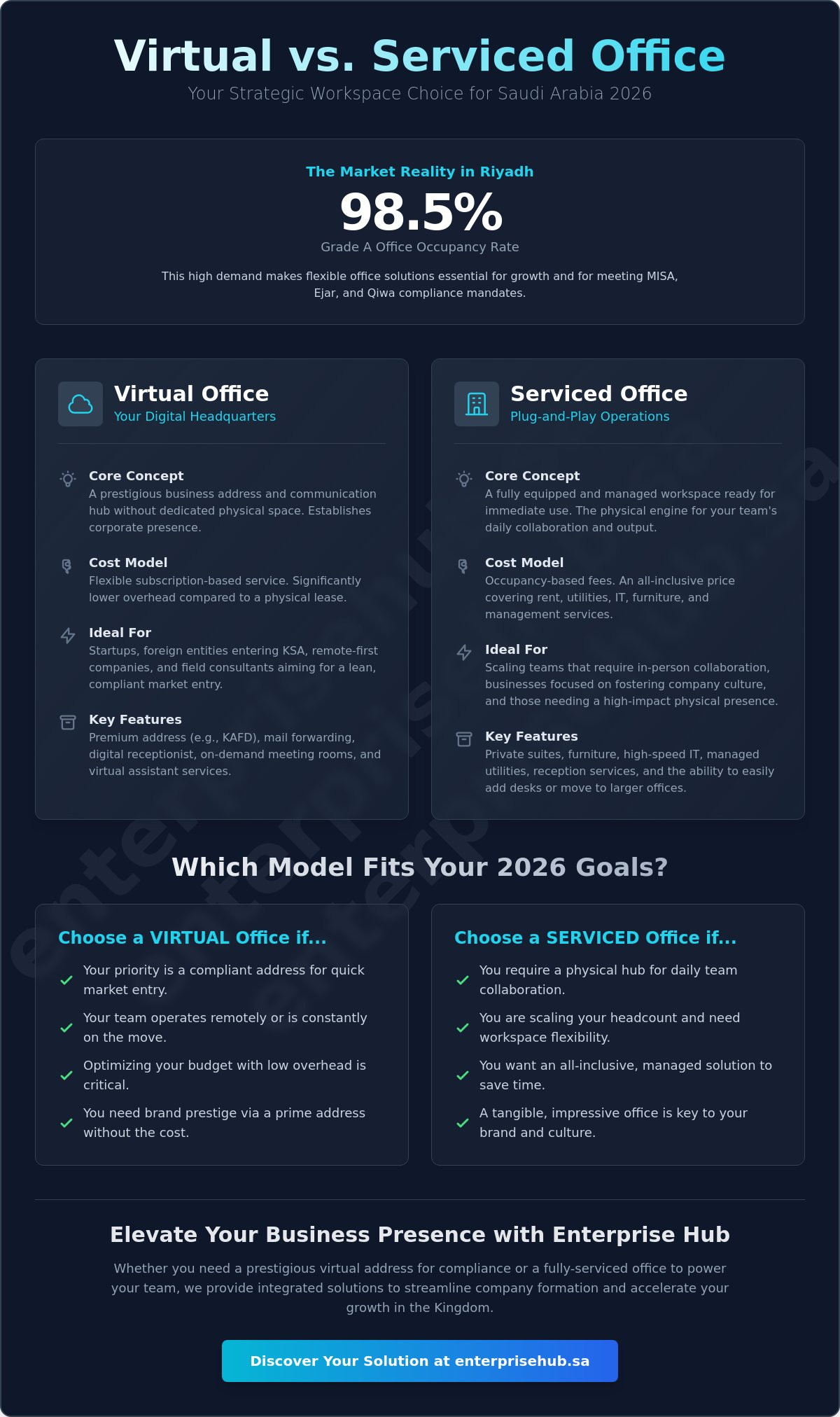
The current 2026 business climate in Saudi Arabia demands extreme agility. With Grade A office occupancy in Riyadh reaching a staggering 98.5%, the traditional long term lease has become a bottleneck for many growing firms. This scarcity has pushed the difference between virtual office and serviced office to the forefront of strategic planning. While both models offer flexibility, they serve entirely different operational purposes. One provides a corporate identity, while the other provides a physical engine for your team’s daily output.
A virtual office serves as a professional business address and communication hub without requiring you to pay for physical desk space you might not use. In contrast, a serviced office is a fully equipped, managed workspace ready for immediate occupation. By 2026, these concepts have merged into a spectrum of choice, allowing investors to match their office footprint exactly to their headcount and regulatory needs. The primary differentiator is simple: physical occupancy versus corporate presence.
The Virtual Office: Your Digital Headquarters
For startups and foreign entities entering the Saudi market, establishing trust is the first priority. A virtual office provides a prestigious address in key districts like KAFD in Riyadh or Tahlia Street in Jeddah, instantly elevating your brand’s image. Core services usually include mail forwarding, a digital receptionist, and access to meeting rooms on an as-needed basis. Understanding What is a Virtual Office? helps clarify how these digital tools allow you to maintain a high-end corporate presence without the high overheads of a dedicated suite. Modern “smart” virtual offices now integrate digital mailroom apps and virtual assistants, making them an ideal foundation for remote-first companies or consultants who spend their time in the field.
The Serviced Office: Plug-and-Play Operations
When your team needs to collaborate in person, a serviced office offers an all-inclusive solution. These spaces come equipped with furniture, high-speed IT infrastructure, and utilities already managed by the provider. You don’t have to worry about the logistics of setting up an office from scratch. This management aspect is vital; outsourcing office operations saves your team hundreds of hours that would otherwise be spent on maintenance or vendor management. It’s a plug-and-play environment where high-impact work begins the moment you walk through the door. For businesses scaling quickly in 2026, the ability to add desks or move into a larger suite within the same building provides a level of scalability that traditional offices simply cannot match.
Ultimately, the difference between virtual office and serviced office comes down to your 2026 growth plan. If your priority is a lean, compliant entry into the market, a virtual setup is your best tool. If you require a physical hub to foster culture and drive performance, the serviced model is the superior choice.
Strategic Comparison: Prestige, Cost, and Flexibility
Selecting the right workspace is a high stakes decision that impacts your capital allocation and brand perception. The fundamental difference between virtual office and serviced office models centers on how you balance immediate cost savings against long term operational efficiency. In the 2026 Saudi market, where agility is a competitive advantage, choosing a model that aligns with your specific growth phase is essential for maintaining a lean yet powerful presence.
Business prestige in Saudi Arabia is often tied to your physical location. Establishing your brand in prime districts like KAFD in Riyadh or Tahlia Street in Jeddah signals stability to clients and investors alike. A virtual office allows you to secure this premium image through a subscription based model, providing the address you need without the overhead of a full suite. However, as your team expands, transitioning to an occupancy based serviced office ensures that your physical environment matches the professional standard your brand projects externally.
Many successful firms now adopt a “Hybrid Middle Ground” to maximize their resources. They utilize virtual services for their primary licensing and mail handling while booking on-demand meeting rooms for high stakes negotiations or board meetings. This approach provides the flexibility to scale your physical footprint up or down based on project demands, ensuring you never pay for square footage that remains empty.
Financial Impact and ROI
While virtual offices offer a low entry cost, serviced offices provide comprehensive value by bundling essential services into a single monthly fee. This model eliminates hidden costs like maintenance, high speed internet, and cleaning services, which often surprise businesses in traditional leases. Total Cost of Occupancy is the definitive metric for 2026 decision-making. By consolidating these expenses, you can accurately predict your monthly burn rate and focus your capital on core business activities rather than facility management.
Operational Flexibility and Speed
Speed to market is a critical factor in the current economic landscape. Both models facilitate rapid expansion, allowing you to establish a presence in a new city in days rather than months. Serviced offices offer the added benefit of easy upgrades; you can move from a two person suite to a larger department wing without changing your contract or address. In a volatile landscape, these flexible contract terms protect you from being locked into rigid, long term commitments that no longer serve your 2026 goals.
Regulatory Compliance and Business Registration in Saudi Arabia
Compliance isn’t just a legal necessity; it’s the foundation of your credibility in the Saudi market. Under Saudi Vision 2030, the business landscape has become highly structured, requiring every entity to have a verifiable point of contact with government authorities. The difference between virtual office and serviced office becomes most critical during the registration phase, as your choice determines which licenses you can obtain and how quickly you can clear regulatory hurdles. Choosing a partner who understands these local nuances ensures your expansion remains on track without unexpected legal delays.
Establishing a business in the Kingdom requires a clear understanding of the Ejar system, the official government platform for commercial leases. Whether you choose a digital or physical footprint, your address must be registered and verifiable to satisfy the Ministry of Commerce and other regulatory bodies. This alignment with national standards is what separates a successful market entry from a stalled application.
Meeting MISA and Ministry Requirements
For foreign investors, a verified business address is non-negotiable. To obtain a Ministry of Investment (MISA) license, you must present a lease contract registered through the Ejar system. Serviced offices are the gold standard for this requirement because they provide the physical documentation and “National Address” needed for immediate approval. While virtual addresses are highly effective for many business types, certain high-regulation sectors or specific MISA categories may require the tangible presence that only a serviced office provides. We’ve seen that having a physical lease simplifies the auditing process and accelerates the issuance of operational permits.
Commercial Registration (CR) Considerations
Issuing a Commercial Registration (CR) is the first major milestone for any Saudi entity. While it’s legal to use a virtual office for company registration, the provider must offer a verified National Address. By 2026, the Saudi government has further integrated digital residency requirements, making it easier for remote-first companies to maintain compliance. However, for activities that involve physical inspections or specific Saudization (Nitaqat) quotas, a serviced office acts as your “Registered Office” for legal service and government visits. It provides a permanent, professional location where authorities can verify your operations, ensuring you stay in the “Green” tier of compliance without the risks associated with unverified addresses.
Strategic growth in the Kingdom depends on navigating these rules with precision. By understanding the difference between virtual office and serviced office in a regulatory context, you can build your business on a compliant, scalable foundation that meets every 2026 mandate.
Decision Framework: Which Office Model Fits Your 2026 Goals?
Choosing the right foundation for your business isn’t a one size fits all decision. It’s a strategic move that dictates your operational speed and financial health. To navigate the difference between virtual office and serviced office effectively, you must look beyond the monthly invoice. You need to evaluate how each model supports your specific 2026 objectives, from hiring local talent to securing high value government contracts. This framework helps you audit your current status and project your future needs with precision.
- Step 1: Assess collaboration needs. Does your team thrive in a remote first environment, or do you require the synergy of a shared physical space to hit your KPIs?
- Step 2: Audit regulatory mandates. Check if your specific license or industry requires a physical footprint registered in the Ejar system to maintain compliance.
- Step 3: Evaluate client interactions. Determine if your business model relies on prestigious, in person meetings to close deals with Saudi investors and partners.
- Step 4: Analyze your capital. Are you prioritizing the lowest possible overhead, or are you ready to invest in a managed environment that maximizes employee productivity?
- Step 5: Project your headcount. Estimate how quickly you’ll need to add physical workstations to accommodate new hires and meet Saudization quotas.
When to Choose a Virtual Office
A virtual office is the ideal tool for testing a new market with minimal financial risk. It’s perfect for consultants, freelancers, and digital agencies that don’t require daily physical presence but need a prestigious national address for branding. If you’re a foreign entity exploring the Saudi market for the first time, this model allows you to establish a compliant corporate identity while you finalize your long term strategy. It’s the leanest way to secure a professional image without committing to square footage you don’t yet need.
When to Upgrade to a Serviced Office
Moving to a serviced office becomes essential when your team requires daily face to face collaboration to build a strong corporate culture. It’s the right choice for companies that need immediate access to high spec IT infrastructure and secure environments. If you’re scaling your team to meet Nitaqat requirements or need to demonstrate a tangible presence to regulators, a serviced suite provides the necessary evidence of your commitment to the Kingdom. You can explore our private office solutions to find a space that scales alongside your 2026 growth plan, ensuring you always have the room to excel.
Ultimately, your choice should reflect where you want your business to be by the end of the year. Whether you’re staying lean or building a massive physical hub, the goal is to remain agile enough to seize every opportunity in the Kingdom’s rapidly evolving economy.
Elevating Your Business Presence with Enterprise Hub
Success in the Saudi market isn’t just about finding a desk; it’s about securing a strategic partner who understands your journey. At Enterprise Hub, we bridge the gap between your vision and the Kingdom’s regulatory reality. We recognize that the difference between virtual office and serviced office choices represents different chapters in your growth story. Our mission is to provide the elite infrastructure and specialized support you need to lead your industry. We don’t just provide space. We provide a launchpad for national success.
Whether you’re a global firm establishing a regional headquarters or a high-growth startup, our integrated ecosystem handles the complexities of the local market. You can focus on your core mission while we manage the operational details. Our prestigious locations in Riyadh and Jeddah serve as a powerful signature for your corporate identity, ensuring you command respect from clients and investors from day one.
Integrated Solutions for Every Stage of Growth
We support your business from the very first step. Our team assists with the intricate process of company formation and government liaison, ensuring you meet every MISA and Ministry requirement with speed. As your operations expand, our flexible models allow you to scale from a virtual presence to a full private suite without the friction of changing your address. For collaborative sessions and high-stakes negotiations, members have immediate access to our state-of-the-art meeting rooms for rent, equipped with the latest technology to impress your stakeholders.
Why National Leaders Trust Enterprise Hub
Our commitment to professional excellence is unwavering. We offer strategic support that goes far beyond providing four walls and a desk. We understand that in the 2026 landscape, the difference between virtual office and serviced office configurations is about how you deploy your resources for maximum impact. We’ve built a managed environment where everything from IT security to government compliance is handled with expert precision. This allows you to remain agile, compliant, and ready to seize every opportunity the Saudi economy presents. Establish your presence with Enterprise Hub today and take the next step in your Saudi success story.
Your business deserves a foundation that matches its ambition. By choosing a partner that integrates workspace solutions with essential government and corporate services, you’re not just renting an office; you’re joining a mission of shared growth and prosperity. Let’s build your future in the Kingdom together.
Securing Your Place in the Future of Saudi Business
Your workspace choice is more than just a line item; it’s the strategic foundation for your growth in the Kingdom. By identifying the core difference between virtual office and serviced office solutions, you’ve gained the clarity needed to align your physical footprint with your 2026 objectives. Whether you prioritize the lean prestige of a virtual address or the operational power of a fully managed suite, your decision ensures your business remains agile in a high-demand market.
Enterprise Hub stands ready to accelerate your journey with expert support for MISA and CR registration. We provide prime national business addresses and fully managed, high-spec office environments that meet the highest professional standards. It’s time to move beyond the confusion of traditional leasing and embrace a solution that scales at your pace. Empower your business with the right office solution at Enterprise Hub and join a community of leaders driving the national economy forward. We’re here to ensure your success is both sustainable and compliant.
Frequently Asked Questions
Can I use a virtual office for my Commercial Registration (CR) in Saudi Arabia?
Yes, you can use a virtual office for your Commercial Registration provided the provider offers a verified National Address. This is a mandatory requirement for the Ministry of Commerce. It’s important to verify that your chosen provider can issue the necessary documentation to satisfy local regulations. Some specific business activities might eventually require a physical lease registered through the Ejar system to maintain full compliance as you scale.
What is included in a serviced office monthly fee?
A serviced office fee typically covers all essential operational costs in a single, predictable monthly payment. This includes high-quality ergonomic furniture, utility bills, daily cleaning services, and professional reception support. It eliminates the need for separate contracts with multiple vendors. This all-inclusive model allows you to focus entirely on your core business growth within the Kingdom without worrying about facility management logistics.
Is it easy to switch from a virtual office to a serviced office?
Switching from a virtual setup to a serviced suite is a seamless process when you work with an integrated provider. Since your business address often remains the same, you won’t need to update your CR or marketing materials. This scalability is a key difference between virtual office and serviced office models. It allows you to add physical workstations instantly as your local team expands to meet new project demands.
How does a virtual office handle my mail and phone calls?
Virtual offices manage your professional communications through a dedicated digital infrastructure. Incoming mail is received at your prestigious business address and can be scanned, held for pickup, or forwarded to your location. Professional receptionists handle your phone calls using your company name. This ensures a consistent and high-end corporate image for your clients and partners in Saudi Arabia, even if you’re working remotely.
Do serviced offices include high-speed internet and IT support?
Yes, enterprise-grade high-speed internet and on-site IT support are standard features of serviced office environments. These facilities are designed for immediate operations, so you don’t have to wait weeks for service installation. Secure, redundant connections ensure your team stays productive. Having on-site technical assistance means any connectivity issues are resolved quickly, which is vital for maintaining high performance in a competitive market.
Which option is better for an international company entering the Saudi market?
The choice depends on your initial headcount and the specific requirements of your MISA license. A virtual office is often the best starting point for testing the Saudi market with minimal risk and low overhead. If you plan to hire a local team immediately to meet Saudization quotas, a serviced office provides the necessary physical hub and regulatory evidence required for long-term operations and employee visas.
Are meeting rooms available if I only have a virtual office subscription?
Meeting rooms are typically available to virtual office subscribers on a pay-per-use basis or as part of a bundled package. This allows you to host professional presentations and board meetings in a high-spec environment without paying for a permanent office suite. It bridges the difference between virtual office and serviced office by offering physical space exactly when you need it for high-stakes client negotiations.
What are the hidden costs of a serviced office compared to a traditional lease?
Serviced offices actually eliminate the hidden costs common in traditional leases, such as fit-out expenses, maintenance fees, and large security deposits. In a traditional lease, you’re responsible for everything from air conditioning repairs to office insurance and furniture procurement. With a serviced model, these costs are bundled into your monthly fee. This protects your cash flow from unexpected operational spikes and simplifies your annual budgeting process.