
By mid-2025, foreign direct investment commitments in Saudi Arabia surged by 25% to reach SAR 222 billion, proving that the Kingdom is no longer just an emerging market but a global powerhouse for growth. You likely recognize this massive potential, yet the technical process of securing a foreign investment license Saudi Arabia MISA often feels like a daunting trek through complex digital portals and strict compliance mandates. It’s natural to feel uneasy about navigating Qiwa, Muqeem, and the Zakat, Tax and Customs Authority while trying to avoid heavy non-compliance fines.
We’re here to turn that uncertainty into a competitive advantage. This guide provides a definitive roadmap to obtaining your MISA license in 2026, ensuring you meet every requirement from document attestation to “Saudization” employment quotas. We’ll break down the exact timelines, such as the 3 to 15 working day processing window for standard activities, and the specific capital requirements like the SAR 30 million needed for 100% foreign-owned trading. You’ll gain a clear checklist for approval and learn how a strategic physical presence serves as your true permit to thrive in the Saudi economy.
Key Takeaways
- Gain clarity on how a foreign investment license Saudi Arabia MISA grants you 100% ownership while positioning your brand within the Kingdom’s Vision 2030 framework.
- Master the document legalization process involving the Saudi Embassy and MOFA to ensure a seamless submission through the official Invest Saudi digital portal.
- Identify the most effective legal structure for your entry, choosing between a Limited Liability Company (LLC) or a Branch office based on your specific commercial goals.
- Navigate the critical post-licensing phase, from securing your Commercial Registration (CR) to registering with the Chamber of Commerce for contract validity.
- Accelerate your market entry by integrating your licensing with professional office solutions and accounting services to achieve immediate operational excellence.
Understanding the MISA Foreign Investment License in 2026
The foreign investment license Saudi Arabia MISA is more than a simple permit; it’s your foundational legal entry point into the largest economy in the Middle East. Issued by the Ministry of Investment (MISA), this document empowers international entities to establish operations with 100% foreign ownership in most sectors. As we move through 2026, the maturity of the National Investment Strategy has transformed the regulatory environment into one of the most competitive globally. We see this license as the strategic bridge between your global expertise and the Kingdom’s ambitious Vision 2030 goals.
While 100% ownership is the standard for service and industrial sectors, some restricted activities still require a joint venture with a local partner. However, the list of restricted sectors continues to shrink as the Kingdom prioritizes ease of doing business. By 2026, the digital integration between MISA and other government entities has reached a level where licensing is no longer a hurdle, it’s a streamlined launchpad. We help you navigate these nuances to ensure your corporate structure aligns with both current regulations and future growth opportunities.
The Strategic Importance of the Regional Headquarters (RHQ) Program
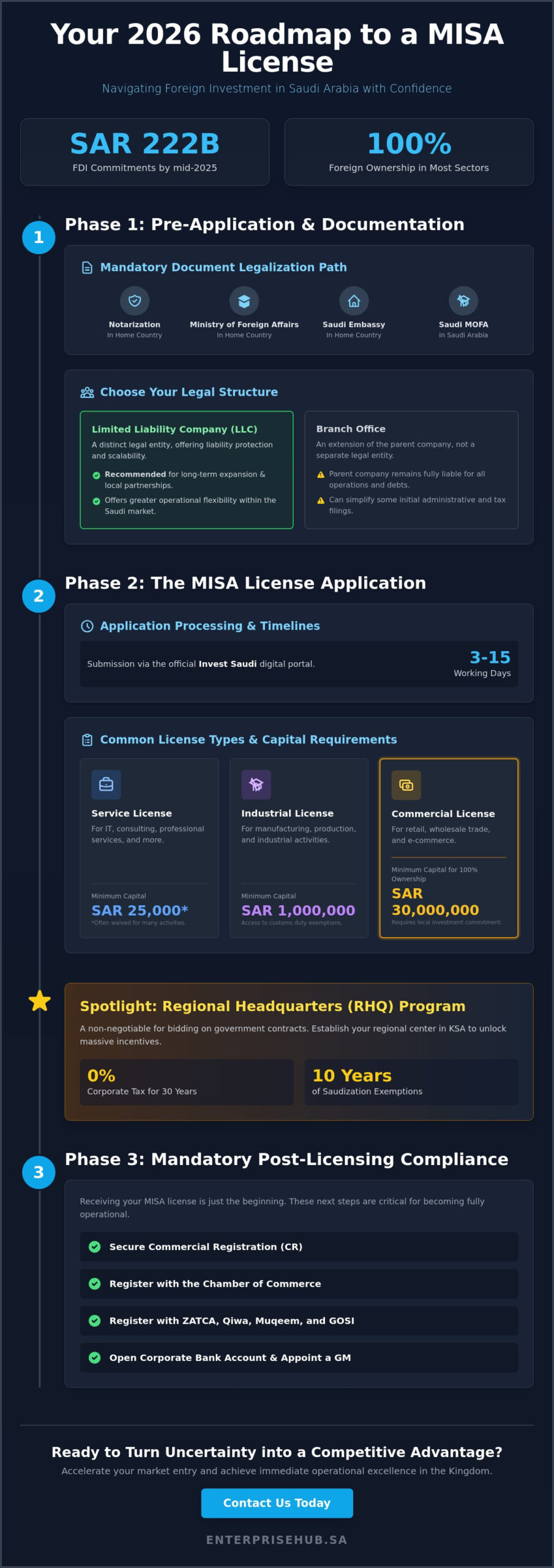
In 2026, the RHQ mandate is a non-negotiable reality for multinationals eyeing government-linked projects. To bid on contracts with any Saudi government agency or state-backed institution, companies must establish their regional center within the Kingdom. We help you leverage the massive benefits of this program, including a 30-year corporate tax holiday at 0% and significant exemptions from standard Saudization quotas for the first ten years. To qualify, your company must demonstrate a presence in at least two different countries excluding Saudi Arabia and your home country. This program isn’t just a requirement; it’s a powerful tool for regional dominance.
Common MISA License Types for Foreign Investors
Selecting the correct license type is critical for your operational scope and capital planning. We guide you through three primary categories to ensure you don’t over-commit capital unnecessarily:
- Service License: This is ideal for IT, consulting, and professional services. It generally requires the lowest capital commitment, with many activities having their minimum capital requirements waived or set as low as SAR 25,000.
- Commercial License: This covers retail and wholesale trade. To maintain 100% foreign ownership, you must commit a minimum capital of SAR 30 million and fulfill specific local investment requirements over a five-year period.
- Industrial License: Designed for manufacturing and production. It requires a minimum capital of SAR 1,000,000 and provides access to specialized customs duty exemptions for raw materials and machinery.
Choosing the right path ensures your business isn’t just compliant, but positioned for maximum operational efficiency. Whether you’re providing high-level consulting or building a manufacturing plant, the foreign investment license Saudi Arabia MISA remains the first step in your Saudi success story.
Phase 1: Pre-Application Requirements and Documentation
Before you log into the official Invest Saudi portal, you must prepare a robust documentation package. Obtaining a foreign investment license Saudi Arabia MISA requires more than just filling out forms; it demands a precise chain of document legalization. Every corporate document from your home country must be notarized, attested by your local Ministry of Foreign Affairs, and finally stamped by the Saudi Embassy. Once these arrive in the Kingdom, the final attestation by the Saudi Ministry of Foreign Affairs (MOFA) makes them legally binding for your application.
You’ll also need to decide between a Limited Liability Company (LLC) or a Branch of a Foreign Company. An LLC is a distinct legal entity that offers greater flexibility for local partnerships and long-term expansion. In contrast, a branch is an extension of the parent company. While a branch can simplify some tax filings, it leaves the parent company liable for Saudi operations. We often recommend the LLC structure for its scalability within the Saudi market. If you’re unsure which path fits your 2026 growth strategy, our company formation experts can help you evaluate the risks and rewards of each.
Financial readiness is the next pillar. While service licenses have flexible capital requirements, a 100% foreign-owned trading license requires a minimum capital of SAR 30 million. You must also appoint a General Manager (GM). This individual doesn’t need to be a Saudi national, but they must eventually obtain a Saudi residency (Iqama) to manage the company’s government portals and banking. We ensure your GM’s credentials meet MISA’s professional standards to avoid application rejections.
Mandatory Documentation Checklist
- Attested Articles of Association (AoA): The governing documents of the parent company, fully legalized.
- Commercial Registration (CR): Proof of the parent company’s legal existence in its home country.
- Audited Financial Statements: Reports for the last fiscal year to prove the parent company’s solvency.
- GM Credentials: A copy of the appointed General Manager’s passport and professional credentials.
Choosing the Right Business Activity (ISIC Codes)
MISA uses the ISIC 4 coding system to categorize every business operation. Selecting the wrong code is a common mistake that leads to major delays in obtaining future permits from the Ministry of Commerce or ZATCA. It’s vital to choose codes that accurately reflect your intended revenue streams. Your specific ISIC activity selection directly dictates your Saudization (Nitaqat) requirements, determining the exact percentage of Saudi nationals you’re legally required to hire to maintain a “Green” status.
Phase 2: The Step-by-Step MISA License Application Process
Once your documents are legalized, you’re ready to enter the digital engine of the Saudi economy. We guide you through the MISA E-Services portal to register your entity as a new investor. This isn’t just a data entry task; it’s the formal presentation of your business case to the Kingdom. The U.S. Department of State’s Investment Climate Statement highlights the significant strides Saudi Arabia has made in digitizing these processes, creating a transparent and efficient environment for international capital. We leverage this efficiency to ensure your application moves through the system without friction.
After creating your account, you’ll upload your legalized Articles of Association and financial statements. We ensure every file meets the specific resolution and format requirements to prevent automated rejections. Once submitted, you’ll receive an invoice for the initial fees. For most sectors, the first-year cost includes a SAR 2,000 license fee and a SAR 10,000 subscription fee for the MISA E-Services portal. Paying this promptly is essential, as the clock for approval only starts once the transaction is verified by the Ministry’s finance department.
Issuance is the final milestone of this phase. Your foreign investment license Saudi Arabia MISA acts as the “birth certificate” of your local entity. It contains your unique license number, which you’ll use for every subsequent government registration, from tax to social insurance. We celebrate this achievement with you, but we also remind you that this is where the real work of operational setup begins.
Navigating the E-Services Portal
Creating your investor account requires a valid email and a clear understanding of your ISIC activities. A common pitfall is uploading documents where the Saudi Embassy stamp isn’t clearly visible; this almost always leads to a rejection. In 2026, standard commercial applications are typically processed within 3 to 15 working days. We monitor your application status daily to address any queries from MISA officials immediately, ensuring no time is wasted.
License Fees and Renewal Cycles
Your license requires annual renewal to remain in good standing with the Ministry. While the first-year subscription is SAR 10,000, be prepared for this to increase to SAR 60,000 in subsequent years, depending on your license type and specific investment incentives. Failing to renew on time results in immediate bank account freezes and the suspension of your government portals. Your General Manager’s residency (Iqama) is also directly tied to the active status of your foreign investment license Saudi Arabia MISA.
Phase 3: Beyond the License – Mandatory Post-Licensing Compliance
Securing your foreign investment license Saudi Arabia MISA is a major milestone, but it doesn’t grant you immediate operational status. You must now secure your Commercial Registration (CR) from the Ministry of Commerce. This document acts as your legal identity for all domestic transactions. Without it, you can’t legally issue invoices or hire staff. Following the CR, you’re required to register with the Chamber of Commerce. This certificate is essential for validating signatures on legal contracts and participating in government tenders in the 2026 market.
Opening a local corporate bank account remains one of the most significant “Day 2” challenges for investors. Banks in the Kingdom adhere to strict “Know Your Customer” (KYC) protocols to comply with global anti-money laundering standards. You’ll need your MISA license, CR, and the General Manager’s residency (Iqama) to initiate this process. Simultaneously, you must register with the Zakat, Tax and Customs Authority (ZATCA). VAT registration is mandatory if your annual taxable supplies exceed SAR 375,000, and corporate income tax for foreign-owned entities is fixed at 20%.
The Physical Office Mandate
A critical rule in 2026 is that you can’t issue a CR or open a bank account without a certified lease recorded in the Ejar system. While virtual offices might suffice for initial MISA approvals in some sectors, most commercial activities require a physical footprint to pass bank inspections and labor office audits. Choosing the right workspace is a strategic decision that impacts your brand’s local credibility. Enterprise Hub provides the necessary physical infrastructure and certified leases that ensure full MISA compliance and operational readiness.
Labor and Social Insurance Portals
Managing your workforce requires navigating three distinct digital portals. First, the Qiwa portal is where you’ll manage all employee contracts and “Saudization” (Nitaqat) quotas. Second, you must open a file with the General Organization for Social Insurance (GOSI) to handle monthly contributions for your team. Finally, the Muqeem portal allows you to manage foreign employee visas and residency permits. If these portals aren’t synchronized, you risk service suspensions and fines. We help you bridge these gaps through our comprehensive government service solutions, ensuring your compliance is automated rather than a burden.
Optimizing Your Market Entry with Integrated Solutions
Securing your foreign investment license Saudi Arabia MISA is your first strategic victory. However, the most successful investors in 2026 don’t treat licensing as an isolated document. They view it as the starting point of an integrated ecosystem. By adopting a single-partner approach, you eliminate the friction of managing separate vendors for legal setup, physical office space, and accounting. This integration ensures that your Ejar lease, ZATCA registration, and bank KYC requirements are perfectly synchronized from day one. We help you avoid the common delays that occur when these critical steps are handled in silos.
Your choice of business address serves as a silent ambassador for your brand. In the Saudi market, a prestigious location in a prime business district does more than provide a desk; it builds immediate trust with local clients and government inspectors. We empower you to transition seamlessly from an initial virtual presence to a fully managed private office as your operations scale. This flexibility allows you to manage costs while maintaining the professional image required for high-stakes government contracts. A physical footprint in a recognized hub is often the deciding factor in passing bank audits and labor office inspections.
Long-term success also hinges on meticulous accounting and tax compliance. With corporate tax at 20% and mandatory VAT filings for businesses exceeding SAR 375,000 in revenue, non-compliance is a risk you can’t afford. We provide the technical expertise to handle these burdens, letting you focus on capturing market share
Accelerate Your Strategic Entry into the Saudi Market
Securing a foreign investment license Saudi Arabia MISA is the definitive first step toward capturing your share of a GDP that reached $1.1 trillion by early 2026. As we’ve explored, success in the Kingdom requires more than just a digital certificate; it demands a seamless transition through post-licensing compliance, from Qiwa registrations to securing a certified physical office. By aligning your corporate structure with the maturity of the National Investment Strategy, you position your brand as a serious contributor to the Saudi economy.
We’re ready to transform these complex regulatory hurdles into a streamlined roadmap for your business. Secure your MISA license and premium office space with Enterprise Hub today to benefit from our strategic advisory for Vision 2030 compliance. We provide fully equipped offices that meet all MISA requirements and expert government relations (GRO) support to handle every portal on your behalf. Don’t just enter the market; thrive in it with a partner committed to your long-term prosperity. Your journey toward economic transformation starts now.
Frequently Asked Questions
Can a 100% foreign-owned company get a MISA license?
Yes, 100% foreign ownership is now permitted across the majority of Saudi Arabia’s economic sectors, including services, industrial, and manufacturing operations. Under current Vision 2030 reforms, international investors don’t need a local partner for most activities. However, specific sectors like trading require a minimum capital of SAR 30 million to qualify for full ownership. Obtaining a foreign investment license Saudi Arabia MISA ensures you retain complete control over your strategic direction while benefiting from the Kingdom’s robust legal protections.
How much does a MISA license cost in 2026?
The standard cost for a new license includes an annual government fee of SAR 2,000 and a first-year portal subscription fee of SAR 10,000. It’s vital to budget for the second year, as the annual subscription fee increases to SAR 60,000 to maintain your active status. These costs cover the digital infrastructure provided by the Ministry and ensure your entity remains in full compliance with ongoing reporting and investment requirements. We help you manage these payments to ensure no lapse in your legal standing.
How long does the MISA license application process take?
Standard applications for commercial and service activities typically take between 3 and 15 working days to process through the Invest Saudi portal. If your business operates in highly regulated sectors like telecommunications, healthcare, or financial services, the timeline extends to 4 to 8 weeks due to additional ministerial approvals. We help you prepare a complete document package to avoid the common back-and-forth queries that can delay issuance beyond these standard windows, ensuring a predictable market entry timeline.
Is a physical office required to obtain a MISA license?
Yes, while you can start the application digitally, a physical office with a certified Ejar lease is mandatory to issue your Commercial Registration (CR). You cannot open a corporate bank account or register for VAT without a verified address in the Kingdom. We provide the necessary physical infrastructure that meets all MISA and Ministry of Commerce standards. This ensures your business has a compliant home that supports your operational growth and satisfies labor office inspections from day one.
What is the difference between a MISA license and a Commercial Registration (CR)?
The MISA license is your permission to invest as a foreign entity, while the Commercial Registration (CR) is your actual legal identity in the Kingdom. Think of the MISA license as the “entry permit” and the CR as your “national ID” for business operations. You must obtain your foreign investment license Saudi Arabia MISA first; only then can the Ministry of Commerce issue your CR. The CR is the document you’ll use to sign contracts, hire staff, and conduct daily business.
Can I change my business activity after the MISA license is issued?
You can amend your business activities, but this requires an official license modification through the MISA E-Services portal. Each new activity must be selected from the ISIC 4 code list and may require additional capital or specific professional certifications for your General Manager. We recommend finalizing your core activities during the initial setup to avoid the administrative fees and potential delays associated with modifying your legal documents later. Our team ensures your initial application covers your full operational scope.
What are the Saudization requirements for new foreign companies?
Saudization requirements are governed by the Nitaqat system, which assigns a color-coded status based on your percentage of Saudi national employees. Most new companies start in a grace period, but you’ll eventually need to meet sector-specific quotas to maintain “Green” status. Maintaining this status is essential for renewing employee visas and accessing government portals. We help you calculate these quotas early to ensure your hiring strategy remains fully compliant with Ministry of Human Resources regulations as you scale.
What is the Regional Headquarters (RHQ) program and do I need it?
The RHQ program is a strategic initiative for multinationals managing operations across the Middle East. If you intend to bid on contracts with Saudi government agencies or state-backed entities, establishing an RHQ is mandatory in 2026. The program offers powerful incentives, including a 30-year, 0% corporate tax holiday and significant exemptions from standard Saudization rules for ten years. It’s a high-level commitment designed for companies looking to make the Kingdom their primary hub for regional dominance and growth.