
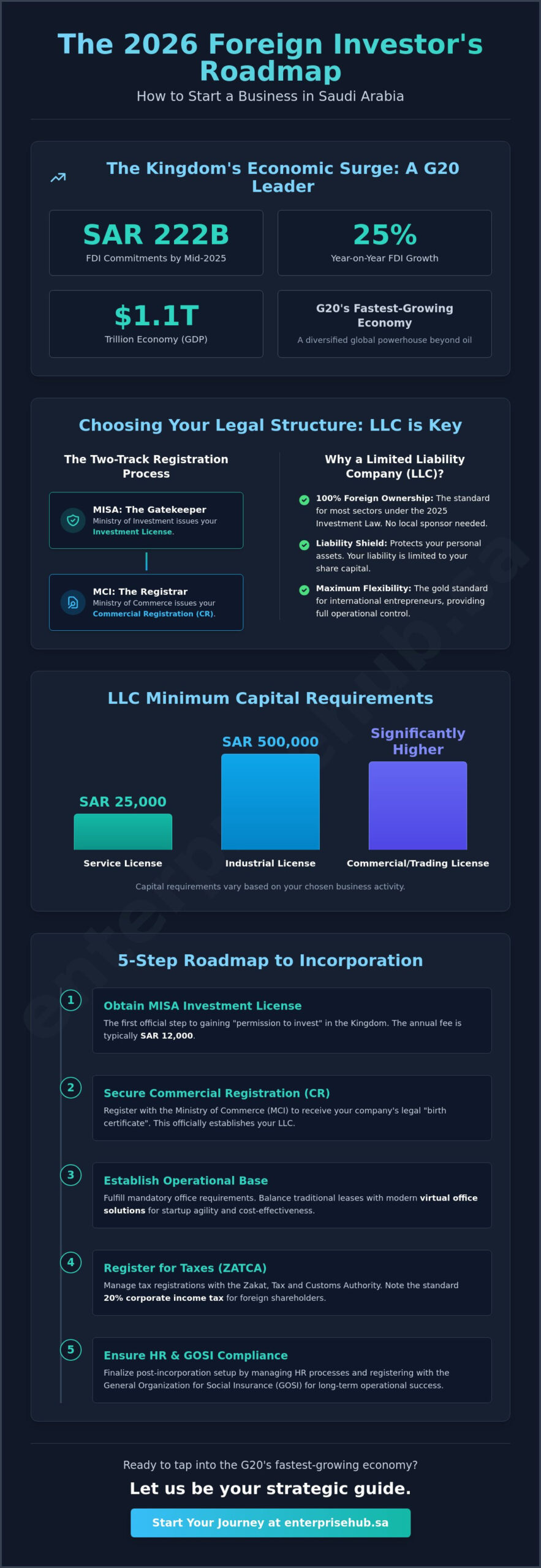
FDI commitments to Saudi Arabia reached SAR 222 billion by mid-2025, marking a 25% year-on-year increase that proves the Kingdom is now a primary global destination for capital. This massive influx shows why so many international entrepreneurs are urgently asking how to start a business in Saudi Arabia as a foreigner to tap into a $1.1 trillion economy. While the opportunity is clear, you’ve likely felt the frustration of complex regulatory shifts or the stress of navigating government portals like MISA and MCI without a definitive roadmap.
We believe that entering a new market shouldn’t feel like a bureaucratic gamble. This guide provides the strategic roadmap you need to master the updated 2025 Investment Law and secure your Commercial Registration with total confidence. We’ll walk you through the essential steps to obtain your MISA service license for its SAR 12,000 annual fee, confirm your 100% ownership eligibility, and establish a compliant operational base in a strategic location.
Key Takeaways
- Understand why the 2026 economic landscape makes Saudi Arabia the G20’s fastest-growing destination for global capital.
- Learn exactly how to start a business in Saudi Arabia as a foreigner by choosing the Limited Liability Company (LLC) structure for maximum flexibility and 100% ownership.
- Master the two-track registration process through MISA and MCI to secure your investment license and Commercial Registration efficiently.
- Navigate mandatory office requirements by balancing traditional lease agreements with modern virtual office solutions for startup agility.
- Streamline your post-incorporation setup by managing ZATCA tax registrations and HR compliance to ensure long-term operational success.
The 2026 Investment Landscape: Why Start a Business in Saudi Arabia Now?
Saudi Arabia enters 2026 as the G20’s fastest-growing economy, a title supported by a massive $1.1 trillion GDP. By mid-2025, Foreign Direct Investment (FDI) commitments reached SAR 222 billion, representing a 25% year-on-year surge. This isn’t just a statistical win; it’s a signal that the Kingdom has successfully transitioned from an oil-dependent nation to a diversified global powerhouse. Vision 2030 has systematically dismantled the barriers that once made international entry difficult. If you’re researching how to start a business in Saudi Arabia as a foreigner, you’re looking at a market that’s more open and digitized than ever before.
The growth is particularly visible in high-priority sectors. Tech firms are flocking to Riyadh’s emerging digital hubs, while tourism and logistics are seeing unprecedented expansion due to Giga-projects like NEOM. The Regional Headquarters (RHQ) program has also reached a critical milestone in 2026. Most global firms now realize that having a physical presence in the Kingdom is no longer optional if they want to secure government contracts or participate in the nation’s rapid transformation. This program has turned Riyadh into a central node for regional trade, making it the logical starting point for any serious international venture.
Foreign Ownership Laws in 2026
The legal framework for international capital changed fundamentally with the updated Investment Law that took effect in February 2025. This landmark legislation streamlined the entry process through Saudi Arabia’s Ministry of Investment (MISA), replacing complex licensing with a faster registration system. Today, 100% foreign ownership is the standard for most sectors, including services, manufacturing, and even agricultural investments. We’ve moved past the old sponsorship models that required a local partner. The current regulatory environment focuses on investor rights and transparency, ensuring that your business remains under your full control from day one.
Strategic Advantages of the Saudi Market
Saudi Arabia offers more than just capital; it offers a tech-savvy population of 37 million people. This young demographic drives demand for digital services, entertainment, and high-end retail. The Foreign Investment Law of 2025 serves as a guarantee of equal treatment for foreign and local investors, which has stabilized capital flow and boosted investor confidence into 2026. By understanding how to start a business in Saudi Arabia as a foreigner, you gain a strategic gateway to the broader GCC and MENA regions. You’ll utilize world-class infrastructure that connects three continents. We help you leverage these advantages by ensuring your setup aligns with these national growth targets from the very start.
Choosing Your Legal Structure: MISA Licenses vs. MCI Registration
Selecting the right legal framework is the most critical decision you’ll make when planning how to start a business in Saudi Arabia as a foreigner. Many investors confuse the roles of the Ministry of Investment (MISA) and the Ministry of Commerce (MCI). Think of MISA as the gatekeeper for foreign capital; they issue the investment license that grants you “permission to invest.” Conversely, the MCI issues your Commercial Registration (CR), which acts as your company’s legal identity or “birth certificate.” You can’t have one without the other. For a seamless entry, you’ll first secure your license through the official MISA portal before finalizing your CR with the Ministry of Commerce.
The Limited Liability Company (LLC) remains the gold standard for international entrepreneurs. It offers a robust shield, ensuring your personal assets aren’t at risk beyond your share capital. Under the current 2026 regulations, an LLC allows for 100% foreign ownership in most sectors. While the standard corporate income tax for foreign shareholders is 20%, the benefits of full operational control and a simplified management structure often outweigh the tax obligations. If you’re serious about investing in Saudi Arabia, the LLC provides the most stable foundation for long-term growth.
The Limited Liability Company (LLC) for Foreigners
Minimum capital requirements for an LLC vary based on your specific license type. For a service license, the minimum capital starts at a manageable SAR 25,000. However, if you’re entering the industrial sector, that requirement jumps to SAR 500,000. For those seeking a 100% foreign-owned commercial or trading license, the minimum capital is set at SAR 30 million. These structures protect you legally while positioning your brand as a serious contender in the local market. We help you evaluate these requirements to ensure your capital structure matches your operational goals from day one.
Branch Offices and Regional Headquarters (RHQ)
Established international corporations often choose to open a Branch Office rather than a new subsidiary. A branch is legally an extension of the parent company, which simplifies some reporting but also means the parent company carries full liability for Saudi operations. By 2026, the Regional Headquarters (RHQ) license has become essential for any global firm aiming to bid on government contracts exceeding SAR 1 million. While an LLC offers faster setup for startups, a Branch or RHQ provides a direct link to global expertise. If you’re unsure which path fits your scale, our consultants can provide a tailored feasibility study to clarify your options.
For specialized consultants, the Technical and Scientific Services Office (TSSO) is another viable route. This structure allows foreign firms to provide technical support to their Saudi distributors without the full overhead of a commercial entity. However, it’s more restrictive than an LLC and doesn’t allow for direct commercial trading. Mastering how to start a business in Saudi Arabia as a foreigner requires choosing the structure that balances your need for speed with your long-term expansion strategy.
Step-by-Step: The Foreigner’s Roadmap to Incorporation
Establishing a presence in the Kingdom is a structured process that has seen massive efficiency gains over the last year. According to the World Bank’s Doing Business report, Saudi Arabia has significantly streamlined the time required to launch a new firm, moving from weeks to just days for many administrative tasks. If you’re learning how to start a business in Saudi Arabia as a foreigner, following the correct order of operations is vital to avoid unnecessary delays or rejected applications.
We’ve broken down the essential roadmap into five manageable stages:
- Step 1: Securing the MISA Investment License. This is your prerequisite for all foreign activity. Without this “permission to invest,” you cannot proceed to commercial registration.
- Step 2: Reserving a Trade Name and Drafting the Articles of Association (AoA). Your trade name must comply with Saudi naming conventions, and your AoA must clearly define your governance structure.
- Step 3: Issuing the Commercial Registration (CR). This is finalized through the Saudi Business Center (SBC), which acts as a one-stop shop for government approvals.
- Step 4: Registering with the Chamber of Commerce and Obtaining a National Address. These are mandatory for legal compliance and for opening your “SPL” (Saudi Post) account.
- Step 5: Opening a Corporate Bank Account. This often becomes the primary bottleneck for foreigners due to strict KYC (Know Your Customer) protocols. It’s best to initiate this as soon as your CR is in hand.
Navigating the MISA Licensing Process
The MISA licensing stage is where we help you ensure your documentation is bulletproof. You’ll need to provide board resolutions and financial statements from your parent company, all of which must be legally translated and attested. In 2026, the approval timeline for a MISA license is typically 3 to 5 business days, provided your documents are in order. We enable you to stay on track by following these proven steps for starting a company, ensuring you don’t miss critical filings during the initial surge of paperwork.
The Critical Role of the Articles of Association
Your Articles of Association (AoA) serve as the constitution of your company. In 2026, these must be notarized electronically via the Ministry of Justice (MOJ) portal. It’s essential to define your business activities correctly at this stage; being too vague can lead to licensing restrictions later, while being too broad might trigger additional regulatory requirements. The CR is the birth certificate of your Saudi entity. Once issued, it unlocks your ability to hire staff, rent property, and sign contracts. Understanding how to start a business in Saudi Arabia as a foreigner means recognizing that while the digital portals are fast, the accuracy of your initial data entry dictates your future operational ease.
Operational Setup: Physical vs. Virtual Office Requirements
Securing a legal address is more than just a logistical milestone; it’s a regulatory necessity for MISA compliance. Once you’ve navigated the initial steps of how to start a business in Saudi Arabia as a foreigner, your focus must shift to establishing a physical or digital footprint that satisfies government inspectors. Saudi authorities generally require foreign companies to maintain a physical office to prove operational substance. While some modern startups utilize virtual offices in Saudi Arabia to maintain a prestigious Riyadh address, these solutions often serve as a bridge before transitioning to a dedicated space required for full visa quotas.
Choosing between a private office and a co-working space depends on your 2026 growth plan. A private office offers maximum control and privacy, which is often preferred by larger corporations and industrial firms. Co-working spaces, however, provide a turnkey solution with lower overhead, making them ideal for tech startups and consultancy firms. Regardless of the choice, your business address acts as a signal of credibility to local banks and high-value clients. A strategic location in a business hub like Riyadh or Jeddah can significantly accelerate your market entry by placing you at the center of the Kingdom’s economic activity.
MISA Compliance and Office Space
The Ministry of Investment (MISA) requires a “Unified E-Lease” (Ejar) to be uploaded to government portals before they finalize certain operational permits. This digital contract is the only lease format recognized by Saudi authorities. We often remind investors that the physical size of your office directly impacts your initial visa quotas under the Nitaqat system. For instance, a larger floor plan may justify a higher number of foreign employee visas. If you’re currently scouting locations, reviewing our curated list of offices for rent is a key operational step to ensure your chosen space meets all regulatory minimums.
Banking Logistics for Foreign Entities
Banking is frequently cited as the most time-consuming phase of the setup process. To open a corporate account, you’ll need your Commercial Registration, MISA license, and the Articles of Association. Most importantly, the bank will require the designated General Manager (GM) to have a valid residency status (Iqama). Banks in 2026 have intensified their “Know Your Customer” (KYC) protocols, often requiring proof of a physical office lease before activating the account. You can expedite this by ensuring your GM is on the ground early and your documentation is fully attested. If you need help securing a compliant space that satisfies both MISA and your banking partner, contact our team for a site selection consultation today.
Understanding how to start a business in Saudi Arabia as a foreigner means preparing for these operational nuances before they become bottlenecks. By aligning your office choice with both your budget and your regulatory obligations, you create a functioning operational base that supports long-term prosperity. We enable you to bypass the common pitfalls of the Saudi real estate market by providing solutions that are fully integrated with the Kingdom’s digital government portals.
Post-Incorporation: Navigating Compliance, Tax, and HR
Securing your Commercial Registration is a landmark achievement, but the operational phase requires a shift toward long-term regulatory discipline. Many investors mistakenly assume the heavy lifting is over once the license is issued. In reality, mastering how to start a business in Saudi Arabia as a foreigner involves managing ongoing monthly and quarterly obligations across several government platforms. You’ll need to register with the Zakat, Tax and Customs Authority (ZATCA) within 60 days of issuing your CR to avoid significant late-filing penalties.
Compliance in 2026 isn’t just about paperwork; it’s about digital integration. Your business must adopt mandatory e-invoicing as part of ZATCA’s ongoing enforcement, which ensures real-time tax reporting for all commercial transactions. Beyond tax, you’ll utilize the Qiwa portal to manage work permits and the General Organization for Social Insurance (GOSI) to handle mandatory social insurance contributions for your entire workforce. We enable you to navigate these systems by providing a centralized compliance roadmap, ensuring you never miss a filing deadline as your operations scale.
Taxation and Zakat for Foreign Investors
It’s vital to distinguish between the tax obligations of local and international owners to plan your cash flow accurately. While Saudi and GCC nationals pay Zakat, a 2.5% levy on wealth, foreign shareholders are subject to a 20% Corporate Income Tax on their share of the company’s net profits. Additionally, if your annual revenue exceeds SAR 375,000, you must register for Value Added Tax (VAT) at the current 15% rate. We also help you manage Withholding Tax (WHT) considerations, which apply to payments made to non-resident entities for services like technical consulting or international royalties. Understanding these nuances is a core part of learning how to start a business in Saudi Arabia as a foreigner with a sustainable financial model.
The “Saudization” (Nitaqat) Framework
The Nitaqat system is the Kingdom’s primary strategy for increasing local employment, and it directly impacts your recruitment strategy. This system categorizes businesses into color-coded zones based on their ratio of Saudi to foreign employees. Your ability to hire international talent and renew residency permits (Iqamas) depends on maintaining a high Nitaqat status. In 2026, renewing an Iqama for a foreign employee costs approximately SAR 9,700 annually, plus mandatory medical insurance which typically ranges from SAR 1,500 to SAR 5,000 per person. Enterprise Hub supports your growth through dedicated government relations (GRO) services, helping you calculate your initial ratios and manage the complexities of the HRSD portal. We ensure your business remains in the Green or Platinum zones, protecting your operational continuity and your talent pipeline.
Accelerate Your Entry into the G20’s Most Dynamic Market
Saudi Arabia’s transformation into a global investment hub is no longer a future projection; it’s a present reality. You now have the strategic roadmap to navigate the updated 2025 Investment Law, from securing your initial MISA license to establishing a compliant operational base. Success in the Kingdom requires more than just a valid Commercial Registration. It demands a precise alignment with ZATCA’s tax regulations and the Nitaqat employment framework. Mastery of how to start a business in Saudi Arabia as a foreigner allows you to tap into a $1.1 trillion economy with 100% ownership and total operational control.
We enable your growth by handling the complexities of the Saudi regulatory landscape so you don’t have to. Launch your Saudi entity with Enterprise Hub’s expert setup services to benefit from end-to-end MISA and MCI licensing support. We provide strategic office solutions in premier business hubs and ensure your business remains fully compliant through comprehensive accounting and tax services. Your vision for expansion deserves a partner that understands the speed of the Kingdom’s transformation. Let’s build your success story together as a key contributor to the Vision 2030 journey.
Frequently Asked Questions
Can a foreigner start a business in Saudi Arabia without a Saudi partner?
Yes, you can achieve 100% foreign ownership in the majority of sectors, including services, manufacturing, and agricultural investments. This elimination of the “sponsorship” requirement is a landmark change that simplifies how to start a business in Saudi Arabia as a foreigner. We enable you to secure full control of your entity without the need for a local Saudi partner, ensuring your strategic interests remain entirely in your hands.
What is the minimum capital required to start an LLC in Saudi Arabia for foreigners?
The minimum capital requirement varies significantly based on your specific license type. For a service-based LLC, the capital starts at SAR 25,000, while industrial licenses require a minimum of SAR 500,000. If you seek a 100% foreign-owned commercial or trading license, the requirement is SAR 30 million. It’s crucial to match your capital structure to your specific business activities during the initial MISA registration phase to ensure full compliance.
How long does the business setup process take for foreigners?
Obtaining your MISA investment license typically takes between 3 and 5 business days in 2026. While the digital issuance of the Commercial Registration (CR) is often nearly instantaneous, the entire end-to-end process including bank account activation and ZATCA registration can take 4 to 8 weeks. We help you navigate these timelines by ensuring all documents are attested and translated correctly before the initial submission.
Do I need to live in Saudi Arabia to own a company there?
You aren’t required to reside in the Kingdom to own a company; however, your business must have a designated General Manager (GM). This GM typically needs to obtain a Saudi residency permit (Iqama) to manage daily operations, sign legal documents, and oversee corporate bank accounts. While the owners can remain abroad, having a localized leadership presence is essential for maintaining compliance with the Ministry of Human Resources and Social Development.
What is a MISA license, and why do I need it?
A MISA license is a mandatory investment permit issued by the Ministry of Investment for all non-GCC entrepreneurs. It acts as your legal “permission to invest” and is the prerequisite for obtaining a Commercial Registration. This license ensures that your business aligns with the Kingdom’s investment laws and qualifies you for the same legal protections and incentives offered to local Saudi businesses under the updated 2025 regulatory framework.
What are the main taxes for foreign businesses in Saudi Arabia?
Foreign-owned entities are subject to a 20% Corporate Income Tax on the portion of profits owned by non-Saudi or non-GCC shareholders. Additionally, a 15% Value Added Tax (VAT) applies to businesses with annual revenues exceeding SAR 375,000. You must also consider Withholding Tax (WHT) on payments made to non-resident service providers, which varies depending on the service type. We provide comprehensive accounting support to ensure these obligations are met accurately.
Can I open a bank account in Saudi Arabia as a foreign business owner?
You can open a corporate bank account once you have secured your Commercial Registration and MISA license. It’s important to note that this phase often requires the most time due to rigorous “Know Your Customer” (KYC) protocols. Banks will require your General Manager to have an Iqama and a registered national address. We help you prepare a bulletproof documentation package to expedite this process with major Saudi financial institutions.
What is the Regional Headquarters (RHQ) program?
The Regional Headquarters (RHQ) program is a strategic initiative requiring multinational firms to establish their Middle East hub in Saudi Arabia. By 2026, obtaining an RHQ license is mandatory for any global company wishing to bid on government contracts valued at more than SAR 1 million. This program offers unique benefits, including a 30-year corporate tax holiday and exemptions from certain Saudization requirements, making it a powerful tool for large-scale international expansion.