
Did you know that Saudi Arabia issued 2,138 new investment licenses in the first quarter of 2024? This 18% increase highlights Riyadh’s position as a premier destination for global capital. While the opportunity is vast, meeting the specific requirements for establishing a foreign investment company in Riyadh often brings unexpected hurdles. You’ve probably felt the frustration of distinguishing between MISA and Ministry of Commerce roles or worried about the high costs of physical office mandates. It’s common to fear that bureaucratic delays might derail your 2026 launch plans.
We believe your entry into the Saudi market should be a seamless transition, not a struggle with paperwork. This expert-led framework helps you master every legal, financial, and logistical detail required to secure your place in the Kingdom’s future. You’ll gain a clear, sequential roadmap for business setup and a deep understanding of 100% ownership eligibility for foreign entities. We’ll also show you how to identify a reliable partner for administrative support so you can focus on growth while we handle the complexity of the local regulatory environment.
Key Takeaways
- Understand how Saudi Vision 2030 facilitates 100% foreign ownership through MISA to position your enterprise for strategic growth in the Kingdom.
- Master the essential requirements for establishing a foreign investment company in Riyadh, including the critical legalization steps for your corporate documentation.
- Navigate the unified Saudi Business Center (SBC) platform to streamline your registration process and meet timeline expectations for your Commercial Registration.
- Identify mandatory post-licensing compliance obligations, such as securing a physical office address and navigating local corporate banking KYC protocols.
- Discover how a strategic partnership with Enterprise Hub accelerates your market entry by integrating business setup services with premium workspace solutions.
Understanding the Regulatory Framework for Foreign Investment
Riyadh’s transformation into a global financial hub isn’t a future goal; it’s a current reality driven by Saudi Vision 2030. For international entrepreneurs, the regulatory environment is now designed to be transparent and welcoming. Saudi Arabia’s Ministry of Investment (MISA) acts as the primary gateway for all foreign capital. It’s the central body that oversees your entry into the market, ensuring your business aligns with national economic goals.
The shift toward 100% foreign ownership has been a game-changer for the Kingdom. Most sectors that previously required a Saudi partner are now open to full international control. You’ll need to distinguish between two critical documents during your setup. The MISA Investment License acts as your permission to invest in the Kingdom. In contrast, the Commercial Registration (CR), issued by the Ministry of Commerce, is the document that legally brings your company into existence. Understanding these requirements for establishing a foreign investment company in Riyadh is the first step toward a successful launch.
While the Kingdom is more open than ever, a “Negative List” still exists. This list identifies specific sectors restricted to foreign investors, such as oil exploration, military catering, and certain real estate activities in the holy cities of Makkah and Madinah. We’ll help you verify your activity’s eligibility before you commit resources to ensure your project doesn’t hit a regulatory wall.
The Role of MISA in 2026
By 2026, MISA has fully matured into a digital-first regulator and business facilitator. The MISA investment license is the mandatory prerequisite for any non-GCC investor seeking to operate within the Kingdom. Automated approval workflows now process standard applications in record time, often within 24 to 48 hours. This efficiency reduces the administrative burden on your team, allowing you to focus on market entry strategies rather than paperwork. We help you navigate these digital portals to ensure your application meets every requirement without delays.
Eligibility and Ownership Structures
Choosing the right legal structure is vital for your long-term success in the Saudi market. Most investors opt for a Limited Liability Company (LLC), which allows for 100% foreign ownership in most commercial and industrial sectors. However, joint ventures with local partners remain strategic in sectors like large-scale construction where local supply chain knowledge is invaluable. You must also decide between a professional license for service-based activities and a commercial license for trading. Each path has distinct requirements for establishing a foreign investment company in Riyadh, including specific capital minimums that vary based on the nature of your business activity.
Core Requirements and Documentation for Foreign Investors
Establishing a business in the heart of the Kingdom’s capital demands a clear understanding of the regulatory framework. The Requirements for establishing a foreign investment company in Riyadh focus heavily on the legal standing and financial health of the parent entity. The Ministry of Investment (MISA) requires you to provide audited financial reports for the most recent fiscal year to confirm your company’s ability to sustain operations. Detailed information on specific license types and their associated benefits is available through the Invest Saudi official portal, which provides the necessary clarity for strategic planning. We help you navigate these initial hurdles by ensuring your financial history aligns with local expectations.
Mandatory Document Checklist
To initiate the setup, you’ll need a specific set of corporate records. A Board Resolution is vital; it must explicitly state the parent company’s intent to establish a subsidiary in Riyadh and name the authorized manager. You’re also required to submit the Articles of Association (AoA) and the Commercial Registration certificate of the parent company. For individual investors, valid passport copies and a detailed CV are necessary. We empower you to organize these files early to avoid delays in the MISA portal submission.
Legalization and Translation Standards
Saudi authorities don’t accept foreign documents at face value. Every international document must undergo a rigorous legalization process. If your country is part of the Hague Convention, you’ll need an Apostille. Otherwise, you must secure attestation from the Saudi Embassy in your home country followed by the Ministry of Foreign Affairs (MOFA) in Riyadh. Accuracy is paramount; every document not in Arabic requires a certified translation from a licensed Saudi translator. It’s also critical to remember the validity rule: many certificates, such as the parent company’s trade license, shouldn’t be older than 90 days at the time of filing.
Minimum capital requirements vary significantly based on your chosen activity. For a standard service license, the minimum capital is typically 500,000 ﷼. However, if you’re looking at 100% foreign ownership in the retail and trading sector, the threshold rises to 30 million ﷼, alongside a commitment to invest 200 million ﷼ over five years. These figures reflect the Kingdom’s drive for high-value, sustainable investments that contribute to the local economy. If you’re ready to begin your journey, our experts can streamline your application process and handle the technical complexities on your behalf.
Success in Riyadh’s competitive landscape begins with compliance. By meeting these Requirements for establishing a foreign investment company in Riyadh, you demonstrate your commitment to the Saudi market and position your brand for long-term growth. We’re here to ensure your documentation is flawless, reflecting the high standards expected in the Kingdom’s business environment.
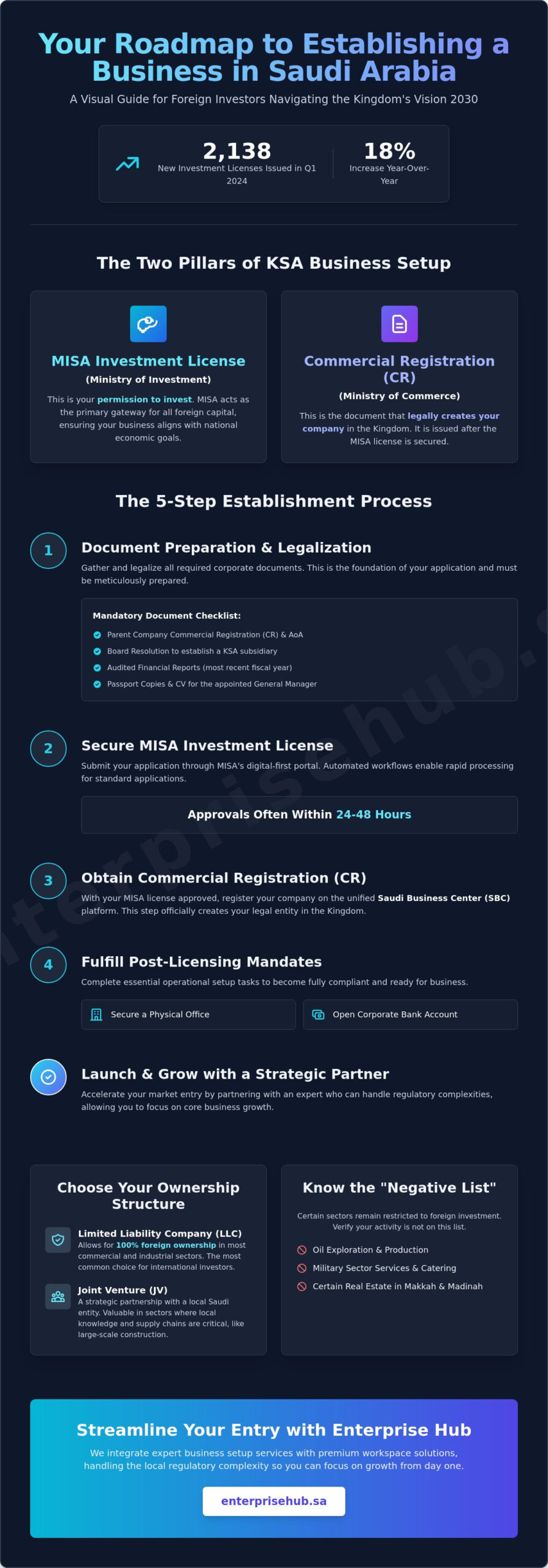
The 5-Step Process to Establish Your Foreign Company
Establishing a commercial presence in Saudi Arabia has evolved from a complex administrative task into a streamlined digital experience. The Saudi Business Center (SBC) platform now serves as the primary engine for this transformation, centralizing services from various government agencies into one unified portal. We empower you to navigate this ecosystem with precision, ensuring your entry into the Riyadh market aligns with the speed of Vision 2030. Success depends on meeting the specific requirements for establishing a foreign investment company in Riyadh while adhering to the latest regulatory updates issued for 2026.
Efficiency is the hallmark of the current system. Most investors can expect to receive their initial approvals within 3 to 5 business days, while the entire process from license application to full tax registration typically spans 15 to 20 days. As highlighted in the U.S. Department of State’s 2024 Investment Climate Statement, the Kingdom’s commitment to legal and regulatory reforms has created a more transparent environment for global capital, significantly reducing the time required to start a business compared to previous years.
Step 1 to 3: Licensing and Name Reservation
We guide you through the Ministry of Investment (MISA) portal to secure your Investment License. This is the foundational document that defines your permitted activities and ownership structure. You’ll need to submit authenticated documents from your parent company, including financial statements and articles of incorporation. Following this, we help you reserve a unique commercial name through the Ministry of Commerce system. This name must be compliant with local naming conventions, avoiding generic terms or restricted words. Once the name is locked, we facilitate the drafting of your Articles of Association (AoA), which shareholders sign electronically via the E-Business portal, eliminating the need for physical presence in many cases.
Step 4 to 5: Registration and Finalization
The final phase involves the issuance of your Commercial Registration (CR) and your mandatory Chamber of Commerce membership. The CR is the official birth certificate of your company, providing the legal identity required to open bank accounts and sign contracts. We then finalize your compliance profile by registering the entity with the Zakat, Tax, and Customs Authority (ZATCA) and the General Organization for Social Insurance (GOSI). These steps ensure you’re fully integrated into the Saudi labor and tax systems from day one.
Understanding the financial commitments is vital for your strategic planning. While costs vary based on activity and capital, common fees include:
- MISA License Fee: 2,000 SAR for the first year, plus a 10,000 SAR annual administrative service fee.
- Commercial Registration: Approximately 1,200 SAR for a five-year period for the main branch.
- Chamber of Commerce Membership: Usually ranges from 2,000 SAR to 10,000 SAR annually depending on the company’s grade and capital.
- Publication Fees: Small administrative charges for the electronic publication of the AoA.
By following these steps, you satisfy the essential requirements for establishing a foreign investment company in Riyadh and position your brand for long-term growth in the region’s most dynamic economy.
Essential Post-Licensing Requirements and Operational Compliance
Securing your MISA license is a major milestone, but it doesn’t mark the end of the journey. To maintain your legal standing and operational readiness, you must complete several critical steps immediately after receiving your Commercial Registration (CR). These requirements for establishing a foreign investment company in Riyadh ensure your business remains compliant with the Ministry of Investment and the Ministry of Commerce throughout 2026.
Physical Presence and the National Address
Saudi Arabia’s regulatory framework emphasizes “economic substance.” You cannot maintain a CR without a verified physical office address. While some service licenses previously allowed more flexibility, MISA now requires most foreign entities to prove they have a functional workspace. A “virtual office” typically won’t suffice for the final issuance of the CR or for opening a bank account.
Your office location must be registered through the National Address system. This digital address links your business to the Zakat, Tax and Customs Authority (ZATCA) and the Ministry of Human Resources and Social Development (MHRSD). It’s the foundation for your “Qiwa” and “Muqeem” accounts, which you’ll use to manage employee contracts and visas. Many investors find that leasing a managed office provides the fastest route to compliance, as these spaces come with pre-verified National Address credentials and meet all civil defense safety standards.
Banking and Financial Compliance
Opening a local corporate bank account is often the most time-consuming part of the post-licensing phase. Banks in Riyadh follow strict “Know Your Customer” (KYC) protocols for foreign-owned entities. You’ll need to present your MISA license, CR, Articles of Association, and the physical presence of your appointed General Manager. We recommend initiating this process as soon as your GM’s investor visa is stamped, as account activation can take 4 to 8 weeks depending on the bank’s internal risk assessment.
- VAT Registration: You must register for VAT with ZATCA if your projected annual taxable supplies exceed 375,000 SAR. Voluntary registration is available for revenues over 187,500 SAR.
- General Manager Appointment: You must officially appoint a GM who resides in Saudi Arabia. This individual is legally responsible for the company’s local operations and must hold a valid Iqama (residency permit).
- Annual Investment Survey: MISA requires all foreign companies to submit an Annual Investment Survey. Failure to provide this data on time can result in fines or suspension of your MISA services.
Meeting the requirements for establishing a foreign investment company in Riyadh involves balancing legal deadlines with operational logistics. Managing these tasks simultaneously ensures your business avoids penalties and starts generating revenue without delay. We provide the strategic support you need to handle these administrative hurdles efficiently.
Ready to secure your physical presence and streamline your compliance? Partner with Enterprise Hub today to navigate the Riyadh market with confidence.
Strategic Support: Streamlining Your Entry with Enterprise Hub
Entering a new market shouldn’t feel like a guessing game. Enterprise Hub acts as your strategic bridge, removing the traditional barriers to entry for international firms. We understand that navigating the Saudi business landscape requires precision and local insight. Our team serves as your local engine, handling the heavy lifting of government relations while you focus on your core growth objectives. This partnership significantly reduces bureaucratic friction, allowing you to launch operations in weeks rather than months.
We provide a seamless synergy between high-level business setup services and premium workspace solutions. Meeting the Requirements for establishing a foreign investment company in Riyadh involves more than just a stack of documents; it requires an integrated operational strategy. We offer comprehensive support that covers:
- Strategic tax planning and VAT registration to ensure 100% compliance.
- Full-scale accounting services tailored to Saudi regulations.
- Dedicated government relations officers (GRO) to expedite all filings.
- Ongoing advisory to align your business with the evolving goals of Saudi Vision 2030.
Comprehensive Setup and Government Services
We manage the entire lifecycle of your application with total transparency. This process begins with securing your MISA investment license and continues through the Ministry of Commerce registration. Our experts handle the technicalities of GOSI for social insurance, Qiwa for labor contracts, and Muqeem for residency permits. We’ve developed specialized company formation guides that break down every regulation for 2026. These resources ensure your workforce is registered correctly and your entity maintains its “Green” status in the Nitaqat system from day one.
Ready-to-Use Infrastructure for Foreign Entities
A major hurdle in the Requirements for establishing a foreign investment company in Riyadh is the mandatory physical office requirement. You cannot obtain your Commercial Registration (CR) without a verified national address. Enterprise Hub solves this hurdle immediately. We provide premium private offices in Riyadh’s most prestigious business districts, providing the exact physical infrastructure required by law. These aren’t just addresses; they’re fully equipped hubs featuring high-speed connectivity and professional meeting rooms. We ensure your first physical footprint in the Kingdom reflects the prestige and ambition of your brand.
Accelerate Your Strategic Entry into Riyadh
Riyadh’s transformation under Vision 2030 has created a high-growth environment where 100% foreign ownership is now a standard reality for many sectors. Navigating the Requirements for establishing a foreign investment company in Riyadh involves a precise 5-step process, from obtaining your MISA investment license to finalizing your commercial registration. Success in 2026 demands more than just paperwork; it requires a deep understanding of local compliance and operational standards to avoid costly delays.
We provide the expertise to bridge the gap between global ambition and local execution. Based in the heart of Riyadh’s business district, Enterprise Hub offers a comprehensive suite of services that covers everything from initial licensing to ongoing accounting and tax compliance. We’ve established ourselves as a trusted partner for global enterprises, ensuring their transition into the Kingdom is seamless and efficient. Our integrated approach removes the administrative burden, allowing you to focus on scaling your operations within the region’s most dynamic economy.
Empower your business entry with Enterprise Hub’s integrated setup solutions
Your journey toward a successful Saudi expansion starts with the right foundation, and we’re ready to help you build it.
Frequently Asked Questions
Can a foreigner own 100% of a company in Saudi Arabia in 2026?
Yes, foreign investors can own 100% of their companies in most sectors including retail, wholesale, and manufacturing. This ownership is granted through a MISA investment license, which eliminates the old requirement for a local partner in these industries. We help you navigate these regulations to ensure you maintain full operational control of your business from day one.
How long does it take to establish a foreign investment company in Riyadh?
The process typically takes 15 to 30 business days from the initial application to the issuance of your Commercial Registration. This timeline depends on the completeness of your documents and the specific activity type you choose. Our team streamlines this process to minimize delays and accelerate your market entry into the Saudi capital.
What is the minimum capital required for a MISA investment license?
There isn’t a fixed minimum capital for most service or commercial licenses, though specific sectors like agriculture require 25,000,000 SAR. For a standard LLC, the capital is usually determined by the business plan you submit to MISA. We assist in calculating the optimal capital structure for your specific requirements for establishing a foreign investment company in Riyadh to ensure regulatory approval.
Is a local Saudi partner required for all business activities?
No, a local Saudi partner isn’t required for the majority of business sectors in 2026. While some specific activities on the “Negative List” still mandate local participation, most professional and industrial licenses allow for 100% foreign ownership. We empower you to choose the legal structure that best fits your strategic goals without unnecessary restrictions.
Do I need a physical office to get a Commercial Registration in Saudi Arabia?
Yes, a registered physical office address is a mandatory requirement for obtaining a Commercial Registration and a MISA license. You must provide a valid lease agreement verified through the Ejar platform to complete your registration. We provide integrated solutions to help you secure a compliant office space in Riyadh that meets all government standards.
Can I open a corporate bank account in Saudi Arabia before my CR is issued?
No, you can’t open a corporate bank account until the Ministry of Commerce issues your Commercial Registration. Banks require the CR and the certified Articles of Association as primary verification documents for KYC procedures. Once these are ready, we support you in navigating the compliance requirements of local Saudi banks to get your finances operational.
What are the main government fees for establishing a foreign company?
The primary fees include 2,000 SAR for the Commercial Registration and a 12,000 SAR annual fee for the MISA investment license. Additional costs involve Chamber of Commerce membership and municipality fees which vary based on your office location and size. These fixed costs are essential for maintaining your legal status and operational compliance in the Kingdom.
What is the “Negative List” in Saudi foreign investment law?
The “Negative List” refers to specific economic sectors where foreign investment is restricted or prohibited, such as oil exploration and military catering. This list is updated periodically by the Saudi government to protect strategic national interests. Understanding these restrictions is a key part of the requirements for establishing a foreign investment company in Riyadh before you begin your application.