
Your initial budget for a MISA license might look perfect on paper, yet many investors find that hidden operational requirements can quickly deplete their starting capital. We recognize that calculating the total company formation costs in Saudi Arabia for foreigners involves much more than just paying a one-time government fee. You likely feel that the distinction between MISA and MOCI regulations, along with the strict mandates for physical office space, creates a level of financial ambiguity that hinders your decision-making process.
We’ve developed this 2026 strategic guide to provide the absolute clarity you need to move forward with confidence. You’ll find a comprehensive breakdown of mandatory fees and a transparent 12 month budget designed to prevent any fiscal surprises during your first year in the Kingdom. We’ll outline the exact steps for MISA license approval and help you identify the legal structure that best aligns with your long-term growth. This is your path to a seamless, well-funded entry into one of the world’s most ambitious markets.
Key Takeaways
- Navigate the 2026 MISA licensing landscape to accurately project company formation costs in Saudi Arabia for foreigners and secure your investment gateway.
- Break down mandatory Commercial Registration and Chamber of Commerce fees to build a precise administrative budget in SAR.
- Compare traditional leases against flexible serviced offices to meet mandatory physical address requirements while optimizing your initial capital.
- Account for post-incorporation operational costs, such as ZATCA registration and GOSI contributions, to ensure long-term compliance and financial stability.
- Leverage Enterprise Hub’s integrated solutions to eliminate hidden fees and accelerate your journey toward operational excellence in the Kingdom.
Understanding the 2026 Saudi Investment Landscape and Initial MISA Licensing
Saudi Arabia stands as a premier destination for foreign direct investment in 2026. The Kingdom’s economic diversification, fueled by Vision 2030, has transformed the business environment into a highly competitive global hub. We enable you to capitalize on this growth by streamlining your entry into the market. A deep understanding of the Economy of Saudi Arabia reveals a system designed to attract tech, manufacturing, and tourism giants. Government initiatives have digitized the incorporation process, allowing investors to secure approvals through unified digital platforms. This efficiency significantly reduces the company formation costs in Saudi Arabia for foreigners by eliminating traditional bureaucratic delays.
The Ministry of Investment (MISA) serves as the primary regulator for all international capital. The MISA license represents the primary legal requirement for achieving 100% foreign ownership in the Kingdom. Without this document, your business cannot obtain a commercial registration or open a local bank account. We help you identify the specific license type that matches your operational goals to ensure compliance from day one.
The MISA Investment License Fee Structure
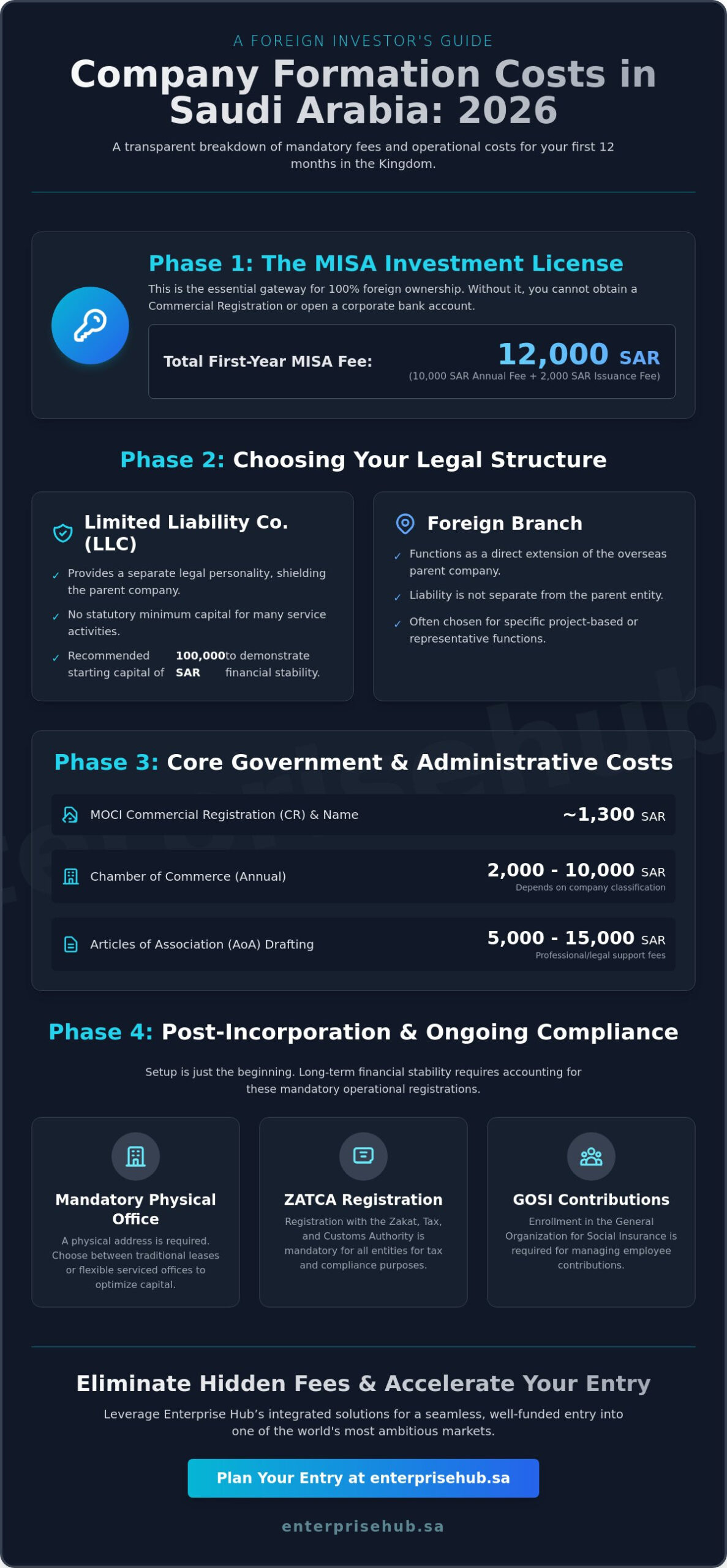
In 2026, MISA maintains a transparent fee structure for international investors. The standard annual service fee for a commercial license is 10,000 SAR, with an additional 2,000 SAR required for the first year of issuance. These costs can vary based on your sector. Tech startups and manufacturing firms often benefit from specialized tracks that offer fee waivers or reduced rates to align with national industrial goals. Tourism ventures may also see specific incentives as the Kingdom targets 150 million annual visitors by 2030.
Legal Entity Selection: Cost vs. Flexibility
Choosing between a Limited Liability Company (LLC) and a Foreign Branch impacts your initial outlay and long-term tax liabilities. An LLC provides a separate legal personality, shielding the parent company from local debts. In contrast, a Foreign Branch functions as an extension of the overseas headquarters. While many service-based LLCs have no statutory minimum capital requirement in 2026, we often recommend a starting capital of 100,000 SAR to demonstrate financial stability to local banks and clients. This decision is a critical component of company formation costs in Saudi Arabia for foreigners because it dictates your future audit requirements and Zakat or income tax obligations. We ensure your entity choice balances setup speed with operational efficiency.
Breaking Down Government Registration and Administrative Costs
Establishing a legal presence in the Kingdom involves a series of structured administrative steps, each with its own set of financial requirements. These government fees represent the baseline of your investment. You’ll find that the Ministry of Commerce (MOCI) has digitized much of this process, yet the costs remain fixed based on your entity type and business activities. The U.S. Department of State Investment Climate Statement confirms that while Saudi Arabia has streamlined its regulatory environment, foreign investors must still navigate specific bureaucratic hurdles to ensure full compliance.
MOCI and Commercial Registration (CR) Fees
Your Commercial Registration (CR) is your company’s primary identity document. For 2026, the standard issuance fee for a limited liability company (LLC) CR is approximately 1,200 SAR. This doesn’t include the name reservation fee, which is often bundled or charged at a nominal rate of 100 SAR. You’ll also need to budget for annual renewal fees that typically match the initial issuance cost.
The total company formation costs in Saudi Arabia for foreigners are heavily influenced by your chosen ISIC4 activity codes. Each business activity you add to your CR can impact your registration tier. Some specialized activities require additional approvals from relevant ministries, which may introduce secondary administrative fees. Chamber of Commerce membership is also mandatory, with fees ranging from 2,000 SAR to 10,000 SAR per year depending on your company’s capital and classification grade.
Professional and Legal Support Fees
Drafting the Articles of Association (AoA) is a critical step that requires precision. You’ll spend between 5,000 SAR and 15,000 SAR for professional drafting and publication in the official gazette. Many investors overlook the hidden costs of document translation. Any document from a foreign parent company, such as board resolutions or certificates of incorporation, must be translated into Arabic by a certified office and attested by the Ministry of Foreign Affairs. This process can cost between 3,000 SAR and 7,000 SAR depending on the volume of paperwork.
Digital platform registrations are the final piece of the administrative puzzle. You’ll need to maintain active accounts on several portals:
- Qiwa: Essential for labor management, costing between 1,265 SAR and 2,645 SAR annually.
- Muqeem: Used for managing residency permits for foreign staff.
- Absher Business: Necessary for various government transactions and authorizations.
While some founders attempt a “DIY” approach to minimize company formation costs in Saudi Arabia for foreigners, this often leads to errors in activity selection or document attestation. Correcting these mistakes later usually costs three times more than doing it right the first time. We help you navigate these complexities by providing comprehensive setup support that aligns with your strategic goals and ensures a smooth entry into the Saudi market.
The Mandatory Office Requirement: A Strategic Cost Analysis
Every foreign entity entering the Kingdom must secure a physical office address before the Ministry of Investment issues a formal license. This isn’t a mere administrative hurdle. It serves as your legal anchor in the Saudi market. According to the latest guidelines from Invest Saudi (MISA), a verified rental contract registered through the Ejar portal is essential for finalizing your commercial registration. When calculating the total company formation costs in Saudi Arabia for foreigners, the office requirement often represents the largest variable expense in the first year. We help you navigate this by identifying spaces that meet regulatory standards without overextending your initial budget.
Serviced Offices vs. Traditional Commercial Leases
Traditional leases require long-term commitments, often three to five years, and high upfront CAPEX for fit-outs and utilities. For a 100-square-meter shell-and-core space in Riyadh, initial setup costs can easily exceed 150,000 SAR before operations begin. We recommend serviced offices for new market entrants because they convert these high setup costs into manageable monthly OPEX. These workspaces provide high-speed internet, reception services, and furniture immediately. If you’re looking for offices for rent in Riyadh, choosing a flexible model can reduce your time-to-market by 60% compared to traditional construction. This flexibility allows you to scale your square footage as your local team grows.
Virtual Offices: A Low-Cost Entry Point?
Virtual offices offer a lean solution, but eligibility under 2026 MISA regulations depends strictly on your license type. Professional services and certain consultancy firms can often utilize virtual addresses to lower their initial company formation costs in Saudi Arabia for foreigners. These subscriptions typically range from 8,000 SAR to 15,000 SAR annually. You must ensure the provider is authorized to issue the documentation required for the Ejar system. As your team grows beyond five employees, transitioning to a physical or hybrid space becomes a regulatory necessity to meet Saudization and labor office requirements.
A prestigious address in a commercial hub like King Abdullah Financial District (KAFD) or Olaya builds immediate trust with Saudi banks during the account opening process. Local financial institutions frequently conduct site visits to verify that a foreign company has a legitimate, operational presence. We assist you in integrating these office costs into your 2026 budget by aligning your real estate choice with your specific license requirements and long-term growth projections. This strategic approach ensures your office is an asset for growth rather than a drain on capital.
- Strategic Tip: Always verify that your office provider can issue a “Unified Ejar Contract” to avoid delays in your MISA license issuance.
- Budgeting: Allocate at least 15% of your setup budget for office-related deposits and registration fees.
Post-Incorporation: Operational and Compliance Costs in 2026
Your business journey doesn’t end once you receive your stamped license. By 2026, the Saudi regulatory environment demands strict adherence to digital integration and transparency. Total company formation costs in Saudi Arabia for foreigners must account for these recurring obligations to ensure long-term stability. We help you transition from a new entity to a fully compliant market leader by identifying these hidden operational expenses early.
Tax and Zakat Compliance Costs
Foreign investors face a 20% Corporate Income Tax on their share of profits. This stands in contrast to the 2.5% Zakat applied to Saudi or GCC partners. You’ll need to budget for ZATCA’s FATOORA (E-invoicing) Phase 2 requirements, which mandate that your accounting software links directly to government systems. Professional VAT filing services typically cost between SAR 2,000 and SAR 5,000 per quarter for SMEs. These requirements are essential components of any Invest in Saudi Arabia 2026 strategy.
Human Resources and Saudization (Nitaqat) Costs
Hiring talent involves more than just salaries. The Ministry of Human Resources and Social Development (HRSD) applies a labor levy through the Qiwa platform. This fee ranges from SAR 7,200 to SAR 9,600 per expat employee annually. You’ll also pay GOSI (Social Insurance) at a rate of 2% for non-Saudi staff to cover occupational hazards. Medical insurance is mandatory for all employees. Expect to pay between SAR 600 and SAR 4,000 per person depending on the coverage level. Your Nitaqat color status directly affects your expansion; maintaining a Platinum or High Green status is vital for securing new work visas quickly.
Maintaining your legal standing requires a clear 12-month compliance calendar. Missing a deadline can lead to frozen bank accounts or suspended licenses. Budget for these annual essentials:
- MISA License Renewal: Approximately SAR 62,000 for most sectors.
- Commercial Registration (CR): Between SAR 200 and SAR 1,200 depending on the entity type.
- Chamber of Commerce Membership: SAR 2,000 to SAR 10,000 based on your capital.
- Annual Audit: External audit fees start at SAR 15,000 for small foreign-owned entities.
- Municipality (Baladiya) Fees: These vary based on office size and location.
Managing these moving parts requires a partner who understands the rhythm of the Saudi market. We enable you to focus on growth while we handle the technical details of your company formation costs in Saudi Arabia for foreigners and ongoing compliance.
Ready to secure your business’s future in the Kingdom? Contact our strategic advisors today for a comprehensive compliance roadmap.
Maximizing ROI: Why Partner with Enterprise Hub for Formation
Success in the Saudi market isn’t just about obtaining a license; it’s about optimizing your entry to ensure long-term profitability. Many investors find that company formation costs in Saudi Arabia for foreigners escalate quickly when they attempt to manage various government departments independently. Enterprise Hub acts as your strategic accelerator, turning a complex bureaucratic journey into a streamlined path toward market leadership.
When you partner with us, you aren’t just hiring a consultant. You’re gaining an operational ally. We focus on three core pillars to maximize your return on investment:
- Risk Mitigation: We eliminate the risk of costly re-applications by ensuring every document meets MISA’s exact specifications the first time.
- Time-to-Market: Our established workflows with government entities can shave months off your setup time, allowing you to start generating revenue sooner.
- Cost Consolidation: By bundling office space, licensing, and legal support, we provide a predictable financial model that prevents “hidden fee” surprises.
Positioning your business for growth within the Kingdom’s elite business ecosystem requires more than just capital. It requires local intelligence. We ensure your brand is perceived as a serious player from the moment you register, helping you avoid the 15,000 ﷼ to 25,000 ﷼ mistakes common among solo entrants who misinterpret local zoning or labor laws.
Integrated Business Setup Solutions
Managing multiple vendors for legal, real estate, and government relations is inefficient and expensive. Enterprise Hub integrates these functions into a single ecosystem. We’ve mastered the intricacies of MISA and MOCI regulations, ensuring your business structure aligns with the latest 2026 legislative updates. Our experts help foreigners navigate دليل تأسيس شركات في الرياض with zero friction. This synergy allows you to focus on your core business while we handle the heavy lifting of compliance and local representation.
Next Steps: Launching Your Saudi Venture
The regulatory landscape in the Kingdom is moving fast. You need a partner who stays ahead of the curve. We customize every formation package to match your 5-year growth plan, ensuring you don’t outgrow your legal structure within eighteen months. Whether you need a prestigious headquarters in Riyadh or a flexible operational hub, we position your brand within the Kingdom’s elite business ecosystem from day one. Don’t leave your investment to chance. Contact Enterprise Hub to get a detailed cost breakdown for your company and take the first step toward a successful Saudi expansion.
Navigate Your Strategic Entry into the 2026 Saudi Market
Understanding the company formation costs in Saudi Arabia for foreigners is the first step toward securing a foothold in a market defined by the ambitious goals of Saudi Vision 2030. By 2026, the investment landscape will reward entrepreneurs who’ve planned for both initial MISA licensing fees and the mandatory requirements of maintaining a physical, MISA-compliant office. These expenses aren’t just administrative hurdles. They’re a strategic entry price into a ﷼3.7 trillion economy that’s rapidly diversifying and opening to the world. You’ve identified the registration fees and the operational compliance needs; now it’s time to execute with precision.
Enterprise Hub acts as your strategic partner to eliminate the guesswork. We provide MISA-compliant office solutions and expert guidance on Saudi Vision 2030 regulations to ensure your setup is seamless and efficient. Our team offers comprehensive accounting and tax support, protecting your bottom line from day one. Start your journey into the Saudi market with Enterprise Hub today and leverage our local expertise to turn your investment into a lasting success story. The Kingdom’s future is bright, and we’re here to help you lead the way.
Frequently Asked Questions
What is the minimum capital required for a foreign company in Saudi Arabia in 2026?
Most foreign investors don’t face a mandatory minimum capital requirement for standard limited liability companies in 2026. While the Ministry of Investment (MISA) previously enforced specific thresholds, current regulations allow for flexible capital structures in most service and retail sectors. You’ll still need to demonstrate sufficient financial solvency to support your business plan during the initial licensing phase.
How much does a MISA investment license cost annually for foreigners?
A MISA investment license costs SAR 62,000 annually for the majority of foreign-owned entities. During your first year, you’ll pay a discounted issuance fee of SAR 2,000 plus a SAR 10,000 service center fee. We help you navigate these company formation costs in Saudi Arabia for foreigners by ensuring your application is accurate to avoid expensive administrative delays.
Are there any tax incentives for foreign investors in Saudi Arabia under Vision 2030?
Foreign investors can access a 0% corporate income tax rate for 30 years by establishing a Regional Headquarters (RHQ) in the Kingdom. Companies operating within designated Special Economic Zones also enjoy customized incentives like VAT exemptions and reduced customs duties. These strategic benefits help lower the long-term operational burden for international firms looking to scale within the Saudi market.
Can a foreigner own 100% of a company in Saudi Arabia?
You can own 100% of your company in Saudi Arabia across most commercial, industrial, and service sectors. This policy eliminates the old requirement for a local Saudi partner, giving you full operational control and total right to profit repatriation. Some specific activities, such as upstream oil and gas or military industries, still maintain specific ownership restrictions or require local participation.
What are the recurring annual costs of maintaining a Saudi commercial registration?
Maintaining a Commercial Registration (CR) involves an annual renewal fee of SAR 1,200 plus Chamber of Commerce memberships that range from SAR 2,000 to SAR 10,000 depending on your business grade. You must also account for National Address subscriptions and municipality license renewals. These fixed expenses are vital parts of the total company formation costs in Saudi Arabia for foreigners.
Do I need a physical office to register a company as a foreigner in Saudi Arabia?
You’re required to secure a physical office space with a verified Ejar lease agreement to complete your company registration. Saudi authorities don’t accept virtual offices for foreign investment entities because a physical site is necessary for labor inspections and opening corporate bank accounts. We help you identify compliant office spaces that satisfy the Ministry of Investment’s regulatory criteria.
How long does the entire company formation process take for international investors?
The entire company formation process typically takes between 3 to 6 weeks for international investors. You can often secure your MISA investment license in just 5 working days, but following steps like tax registration and bank account activation require additional time. Having your documents notarized and translated correctly from the start prevents unnecessary setbacks in this timeline.
What are the costs associated with hiring foreign employees (Iqama fees) in 2026?
Hiring foreign employees in 2026 requires an annual work permit fee of SAR 9,600 per worker. You’ll also need to budget SAR 650 for the Iqama issuance and between SAR 1,000 and SAR 3,000 for mandatory medical insurance. These costs can fluctuate based on your company’s Nitaqat status and the specific ratio of Saudi nationals to expatriate staff in your workforce.