
The era of expatriates being restricted to employee status in the Kingdom officially ended with the January 2026 regulatory updates. You’ve likely spent years contributing to the local economy while feeling that full legal ownership of your own venture was a distant, expensive dream. Many residents still believe that الاستثمار في السعودية للمقيمين requires millions in upfront capital or impossible bureaucratic hurdles. We understand these concerns because we see how the complexity of MISA licensing and government digital portals can feel like a barrier to your professional growth.
It’s time to change that perspective. This guide serves as your strategic roadmap to navigate the 2026 investment landscape, ensuring you gain 100% ownership and a secure residency through your business. We’ll show you how to satisfy MISA requirements without the typical stress, from finding compliant office spaces to mastering the latest digital filing systems. You’ll discover the exact steps to transition from a professional employee to a key player in the thriving Saudi national market as part of the Vision 2030 transformation.
Key Takeaways
- Learn how to leverage the 2026 investment landscape to transition from an expatriate employee to a business owner with full ownership under Vision 2030.
- Identify the specific financial solvency standards and documentation required to successfully secure your MISA license for الاستثمار في السعودية للمقيمين.
- Evaluate the strategic advantages of an LLC versus a Sole Proprietorship to determine the best legal structure for your long-term operational control.
- Follow a streamlined roadmap to navigate the transition from obtaining your investment license to issuing your Commercial Registration and Articles of Association.
- Stay ahead of regulatory requirements with a comprehensive compliance calendar designed to manage tax filings and license renewals for sustained growth.
The 2026 Landscape: Investment in Saudi Arabia for Residents
Saudi Arabia’s economic transformation has reached a definitive peak in 2026. The National Investment Strategy has successfully diversified the economy, pushing non-oil GDP contributions toward the 50% target. For expatriates, this means the concept of الاستثمار في السعودية للمقيمين has evolved from a niche opportunity into a mainstream career path. Residents no longer view the Kingdom solely as a place for temporary employment; they see it as a primary market for long-term capital growth and equity ownership.
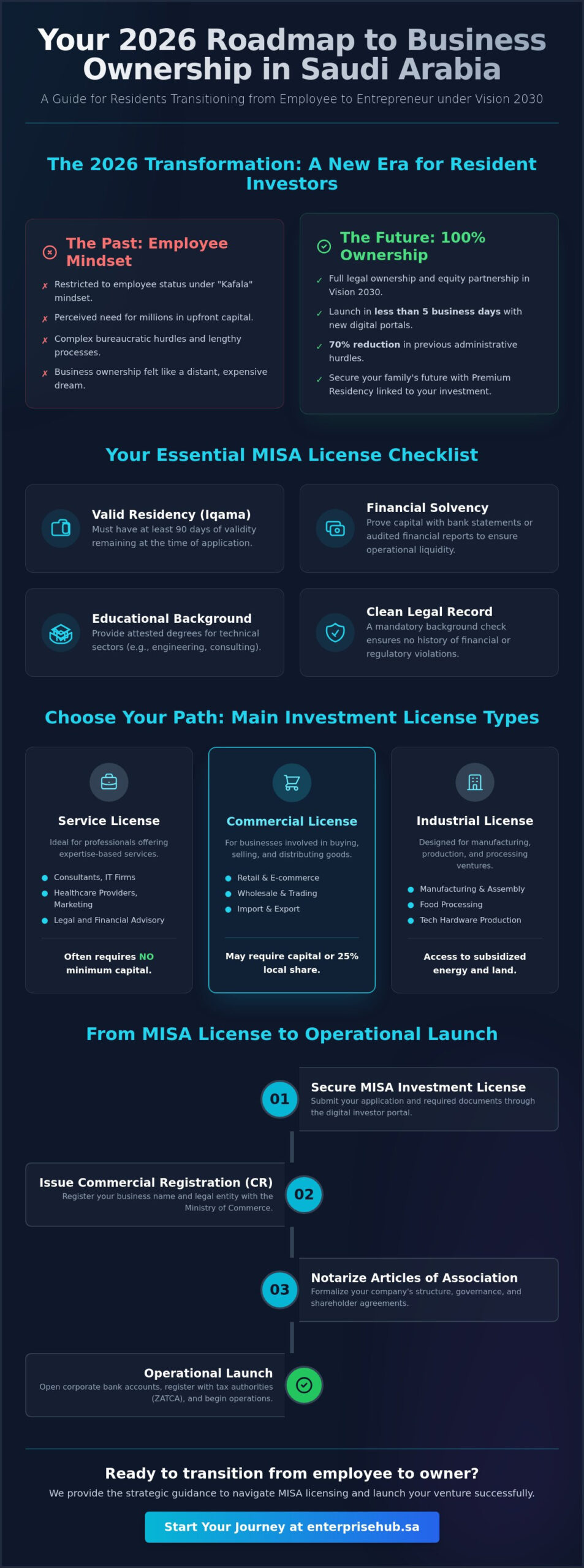
The Ministry of Investment (MISA) updated its resident investor portal in early 2026 to provide a fully digital onboarding experience. This shift removed 70% of previous administrative hurdles, allowing residents to transition from employee status to business owner in less than five business days. We’ve moved past the traditional “Kafala” mindset. We’re now in an era where professional residents act as equity partners in the Kingdom’s future, moving beyond the limitations of fixed salaries to build scalable assets.
Why Residents are Choosing Entrepreneurship Now
Market stability is the primary driver for this shift. In 2025, the SME sector’s contribution to the GDP reached 35%, creating a robust ecosystem for resident-led startups. Non-oil sectors like tourism, renewable energy, and digital logistics haven’t just grown; they’ve become the economy’s backbone. The 2026 Premium Residency updates specifically link investment thresholds to permanent residency rights, allowing residents to secure their family’s future through business ownership rather than just job contracts. It’s a strategic move that aligns personal wealth with the Kingdom’s sovereign goals.
Legal Foundations for Resident Investors
Understanding the Foreign Investment Law is the first step toward a successful setup. This law ensures that resident-owned companies receive the same treatment, incentives, and protections as local firms. MISA acts as the primary regulator, overseeing the issuance of licenses and ensuring compliance with the latest 2026 standards. We help you navigate these regulations to ensure your venture stands on solid legal ground from day one.
The licensing framework is categorized to suit different business models:
- Service Licenses: Ideal for consultants, IT firms, and healthcare providers, often requiring no minimum capital.
- Commercial Licenses: Required for retail and wholesale trade, typically involving a 25% local shareholding or specific capital requirements in SAR.
- Industrial Licenses: Designed for manufacturing ventures, offering subsidized energy rates and land in industrial cities.
Choosing the right path for الاستثمار في السعودية للمقيمين requires a deep dive into these categories. Each license type carries different tax implications and Saudization requirements that we must calculate before you commit your capital.
Essential Requirements for Resident Investment Licenses
Securing a license to operate within the Kingdom is a foundational step for any resident entrepreneur. The process of الاستثمار في السعودية للمقيمين is governed by the Ministry of Investment, which ensures that all participants contribute meaningfully to the national economy. You’ll need to prepare a comprehensive dossier that proves both your financial stability and professional competence. The government’s focus in 2026 remains on high-value projects that drive innovation and local employment.
- Valid Residency Status: You must hold an Iqama with at least 90 days of validity remaining at the time of application.
- Financial Solvency: The government expects proof of capital through bank statements or audited financial reports. This ensures you have the liquidity to sustain operations without immediate external credit.
- Educational Background: For technical sectors like engineering, legal services, or specialized consulting, you’ll need to provide academic degrees attested by the Saudi Ministry of Education or relevant professional bodies.
- Clean Legal Record: A mandatory background check is conducted to ensure the investor has no history of financial crimes or regulatory violations.
We help you navigate these requirements by providing a clear roadmap for document preparation. It’s not just about having the papers; it’s about presenting a case that aligns with the Kingdom’s 2030 vision for high-quality growth. If you need help verifying your eligibility, our consultants can review your profile to ensure it meets current 2026 standards.
The Digital Application Process via MISA
The journey begins on the official MISA portal, known as “Invest Saudi.” You’ll start by creating an account and selecting your specific business activity. In 2026, the digital verification system is highly integrated, meaning any discrepancies in your Iqama or financial data will trigger immediate delays. To avoid bottlenecks, ensure all foreign documents are attested by the Saudi Embassy and translated by a certified office. We’ve seen most applications reach initial approval within 3 to 5 business days when the data is perfectly aligned. Once approved, the system issues an investment license that serves as the cornerstone of your legal presence.
Capital and Fee Structures
Capital requirements for الاستثمار في السعودية للمقيمين vary significantly by sector. While service-based licenses might not require a specific minimum capital, industrial or trading licenses often demand substantial investments. For instance, a 100% foreign-owned retail entity typically requires a minimum capital of 30,000,000 SAR. Annual licensing fees for resident-owned firms currently hover around 2,000 SAR for the basic license, plus a 10,000 SAR government service fee. For long-term financial planning, you should also account for Commercial Register Renewal Fees to ensure your business remains compliant throughout its lifecycle.
Comparing Business Structures: Sole Prop vs. LLC for Residents
Choosing the right legal entity is the first critical decision for any resident eyeing الاستثمار في السعودية للمقيمين in 2026. This choice isn’t just administrative; it defines your risk profile, tax burden, and ability to scale. We help you navigate these choices by aligning your vision with the Kingdom’s evolving regulatory framework, ensuring your setup is both compliant and competitive.
The Limited Liability Company (LLC) has emerged as the gold standard for resident investors. Since the implementation of the New Companies Law in early 2023, the flexibility of this structure has increased significantly. It allows for a single-member ownership, meaning a resident can maintain 100% control without the mandatory requirement of a local partner in most commercial sectors. This independence is a major draw for those looking to build a legacy within the Saudi market.
The LLC Advantage in the Saudi Market
Most 2026 investors prefer the LLC because it builds immediate trust with local banks and government entities. When you apply for a license through the Ministry of Investment (MISA), the LLC structure signals a commitment to professional governance. Key requirements include:
- Management: You can appoint one or more managers, and they don’t necessarily have to be shareholders.
- Shareholders: A minimum of one shareholder is required, and there’s no longer a rigid ceiling on the maximum number.
- Partnerships: While 100% foreign ownership is common, partnering with Saudi nationals remains a strategic move for sectors requiring deep local networking or specific “Saudi-only” activities.
Liability protection is the primary differentiator that saves personal assets. In a Sole Proprietorship, your personal bank accounts and property are legally tied to the business. If the business incurs debt, you’re personally responsible. The LLC creates a “corporate veil,” limiting your financial exposure to the amount of capital invested in the company. From a tax perspective, resident-owned corporate entities generally pay a 20% income tax on net profits, while Saudi-owned shares are subject to a 2.5% Zakat. We ensure you understand these fiscal nuances before you sign your articles of association.
Strategic Selection Framework
Your decision should depend on your specific sector, available capital, and risk appetite. If you’re entering high-growth areas like tech or logistics, the LLC’s ability to attract future investors is non-negotiable. For those focusing on small-scale specialized consultancy, a Sole Proprietorship might offer lower overhead, but it often limits your ability to win large government tenders. We recommend following a structured approach to starting a company in the Kingdom to ensure your foundation is solid from day one.
Future-proofing your الاستثمار في السعودية للمقيمين is also possible. You can transition from a Sole Proprietorship to an LLC later, but it involves significant re-licensing fees and legal updates. It’s usually more cost-effective to start with the structure that matches your three-year growth plan rather than your day-one size.
From MISA License to Operational Launch
Securing a MISA license is the first milestone for الاستثمار في السعودية للمقيمين. It transforms your legal status from an employee or resident to a formal business owner. Once you hold this license, you’ll draft your Articles of Association and issue a Commercial Registration (CR) through the Ministry of Commerce. This process is now 100% digital for most sectors, reflecting the efficiency goals of Vision 2030. You must then register with the Chamber of Commerce and establish a National Address. Finalizing the setup involves opening a local corporate bank account and registering for VAT with ZATCA if your projected annual revenue exceeds SAR 375,000.
- Step 1: Apply for the MISA Investment License via the Ministry of Investment portal.
- Step 2: Issue the CR and notarize the Articles of Association.
- Step 3: Register with the Chamber of Commerce and activate your National Address.
- Step 4: Lease a physical or certified virtual office that meets Balady and MISA standards.
- Step 5: Open your corporate bank account and register for tax (Zakat/VAT).
The Role of Professional Workspace in Licensing
By 2026, compliance audits have become significantly more rigorous. A ‘dummy’ office or a residential address won’t pass the Ministry of Investment’s inspections. You need a physical presence in a licensed business center or a private office in a recognized hub. These spaces don’t just provide a desk; they offer the credibility required to attract local partners and high-tier talent. You can leverage government services for companies to streamline these approvals and ensure your workspace meets every municipal regulation from day one.
Digital Integration: Qiwa, Absher, and Muqeem
Your operational success depends on mastering the Kingdom’s digital ecosystem. Qiwa is the primary platform for managing labor contracts and meeting Saudization (Nitaqat) targets. As a resident investor, you’ll use Muqeem to manage employee visas and Absher Business for corporate administrative tasks. It’s also vital to protect your intellectual property early. Integrating Trademark Registration into your setup phase ensures your brand assets are legally shielded as you scale. This digital-first approach is central to الاستثمار في السعودية للمقيمين, allowing you to manage your entire operation through integrated government portals.
Ready to navigate the licensing journey without the stress of administrative delays? Launch your Saudi enterprise with confidence through our expert advisory services.
Sustaining Growth: Compliance and Support Systems
Establishing your business is only the first milestone. Long-term success in الاستثمار في السعودية للمقيمين depends on rigorous adherence to the Kingdom’s evolving regulatory framework. By 2026, the integration of digital government services has made compliance more transparent, but it requires consistent attention to detail. You must transition your mindset from an individual resident to a corporate leader responsible for local talent and national contributions.
The shift from “Expat Employee” to “Expat Employer” involves significant administrative changes. You’ll manage your company’s files on the Muqeem portal, handle GOSI (General Organization for Social Insurance) registrations for your staff, and ensure your Saudization ratios align with Nitaqat requirements. Success here means building a professional infrastructure that supports your vision while respecting the local labor laws that govern the Saudi market.
Support for resident-led startups has expanded through initiatives by Monsha’at (the Small and Medium Enterprises General Authority). Resident investors can now access various SME support programs, including training workshops and technical consultancy. Financing through the Kafalah program provides loan guarantees that help bridge the gap between ambitious business plans and the capital required for expansion. These resources ensure that الاستثمار في السعودية للمقيمين is backed by a robust national ecosystem designed for shared prosperity.
Accounting and Tax Obligations in 2026
Tax compliance is a pillar of business sustainability in Saudi Arabia. Under current regulations, the non-Saudi share of a company’s income is subject to a 20% corporate income tax. This differs from the Zakat requirements applied to Saudi and GCC nationals. You must register with the Zakat, Tax and Customs Authority (ZATCA) immediately after receiving your Commercial Registration.
- Audited Financials: You’re required to upload audited financial statements to the Qawaem platform annually. This is a mandatory step for the renewal of your MISA investment license.
- VAT Compliance: If your annual taxable supplies exceed SAR 375,000, VAT registration is compulsory. Ensure your point-of-sale systems are compatible with ZATCA’s Phase 2 “Integration Phase” requirements.
- Withholding Tax: Be aware of withholding taxes on payments made to non-resident parties, which can range from 5% to 20% depending on the service type.
The Enterprise Hub Advantage
We provide the strategic foundation you need to thrive in the Saudi market. Enterprise Hub doesn’t just offer a space; we offer a comprehensive growth ecosystem. Our integrated solutions cover everything from initial business setup services to providing premium private offices that reflect your brand’s professional standing. We remove the operational friction so you can focus on scaling your operations.
Our hubs serve as high-level networking environments where you can connect with mentors, industry experts, and potential local partners. We understand the nuances of the Saudi business landscape and provide the operational excellence required to maintain compliance effortlessly. By joining our community, you gain a partner dedicated to your long-term excellence. Start your investment journey with Enterprise Hub today and secure your place in the Kingdom’s future.
Launch Your Strategic Expansion in Saudi Arabia
Saudi Arabia’s 2026 economic landscape offers a unique window for resident investors, especially as the Kingdom targets 3.3 trillion SAR in cumulative investment by 2030. Success depends on securing the right MISA license and selecting a business structure that aligns with your long-term goals. Navigating these regulatory frameworks requires precision and local expertise. We simplify the journey of الاستثمار في السعودية للمقيمين by providing comprehensive support from initial licensing to operational stability. You’ll gain access to premium private offices in strategic economic hubs and full assistance with accounting, tax, and corporate compliance. Our team’s deep knowledge of government services ensures your business remains compliant while you focus on growth. Don’t let administrative hurdles slow your ambition in one of the world’s fastest-growing economies. Empower your business with Enterprise Hub’s integrated setup and office solutions. Your vision for a successful Saudi enterprise is within reach and we’re ready to build it together.
Frequently Asked Questions
Can a resident own 100% of a company in Saudi Arabia in 2026?
Yes, you can own 100% of your company as a resident in 2026 through the Ministry of Investment (MISA). Most commercial, industrial, and service sectors allow full foreign ownership without the need for a local partner. We guide you through the specific licensing requirements to ensure your business structure complies with the latest regulatory updates under Vision 2030.
What is the minimum capital required for a resident to get a MISA license?
Minimum capital requirements depend entirely on your chosen business activity. While service licenses often require a nominal capital of 25,000 SAR, a trading license requires a minimum of 30,000,000 SAR with a 20,000,000 SAR contribution from the investor. We help you determine the exact financial threshold for your sector to ensure your application meets MISA standards without unnecessary capital lockup.
Does a resident investor need a Saudi sponsor (Kafeel) for their business?
You don’t need a Saudi sponsor or Kafeel when you operate under a MISA investment license. This license allows you to be self-sponsored, granting you full legal control over your entity and residency status. It’s a fundamental shift in the landscape for investment in Saudi Arabia for residents, providing the autonomy needed for long term strategic growth and operational independence.
Can I convert my existing work visa into an investor visa?
Yes, you can transition from an employment visa to an investor visa after securing your MISA license. This process involves a status change at the Ministry of Interior and doesn’t usually require you to exit the country. Our team manages the documentation and coordination between government departments to make this transition seamless. It’s a practical way to move from being an employee to a business owner.
What are the tax rates for resident-owned businesses in the Kingdom?
Resident-owned businesses pay a flat 20% corporate income tax on their annual net adjusted profits. If your annual taxable sales exceed 375,000 SAR, you’ll also need to register for a 15% Value Added Tax (VAT). Unlike Saudi nationals, foreign investors aren’t required to pay the 2.5% Zakat. We provide integrated solutions to help you manage these tax obligations while maintaining full compliance with ZATCA regulations.
How long does it take to complete the business setup process for residents?
The entire setup process typically takes between 15 and 30 working days to complete. This timeframe covers obtaining the MISA license, issuing the Commercial Registration, and registering with the Chamber of Commerce. We accelerate this timeline by ensuring all documents are pre-verified and submitted correctly. Our goal is to minimize administrative delays so you can start your operations as quickly as possible.
Is a physical office required for a MISA license in 2026?
A physical office space is mandatory for all MISA-licensed entities to obtain a Commercial Registration. You must provide a verified rental contract through the Ejar platform to prove you have a legitimate place of business. Virtual offices don’t meet the current regulatory requirements for foreign investors. We assist you in finding compliant office locations that suit your budget and meet all government specifications.
What sectors are restricted for resident investors in Saudi Arabia?
Residents are restricted from investing in a limited “negative list” that includes oil exploration, military catering, and real estate in Makkah and Madinah. Most other sectors are fully open, making investment in Saudi Arabia for residents a highly viable path in retail, technology, and manufacturing. We help you navigate these restrictions to find high-growth opportunities that align with your expertise and the Kingdom’s economic goals.